

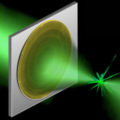
A virtual lens created by two counterpropagating laser beams promises incredibly fast shutter speeds, making the real-time observation of matter at the molecular level a real possibility, says a team of scientists at the University of Nebraska-Lincoln (UNL). Writing in theProceedings of the National Academy of Sciences, the scientists explain how the laser beam lens would keep pulses of electrons from dispersing and instead focus the electron packets on a target. Impressively, the lens theoretically offers an effective “shutter speed” that would be measured in femtoseconds (quadrillionths of a second) and attoseconds (quintillionths of a second).
UNL physicist Herman Batelaan offers an analogy to help illustrate the incredible timescales involved. “One attosecond is to one second as one second is to the age of the universe. The timescales involved here are daunting,” Batelaan said. “A crisp image of the seams of a thrown baseball can be made with a strobe pulse of about one 10 millionth of a second. Taking a crisp image of an atom in a molecule is much more demanding. Pulses that are a billion times shorter than that are needed. Anything produced to date is 50 times slower than that and making movies of most molecules has stayed out of reach. The new idea is that a temporal lens exists and obeys the same laws as a spatial lens. That’s what we showed in this paper. Nobody had ever used a temporal lens to get a higher resolution.”
“It’s great that we were able to take a very simple idea – at least in physics – and produce a paper like this,” Hilbert added. “The lensmakers’ equation is something you learn in intro to optics, so pretty much any undergrad in physics learns this stuff. But now we’ve applied it to time, which no one has ever thought of in this way before. You could explain this to intro undergraduate students and they would get the idea. It’s very simple, but it’s also very powerful.”
Related:
Intra-Molecular Movement Of Protons Observed
Pimp My Electron Microscope




Comments are closed.