Home   |   News   |   Discussion Forum   |   Books   |   Curiosity Shop
Discussion Forum
Recent Posts
The platypus genome sequenced
redewenur
Today at 12:55 AM
Philosophy of Religions--all religions, including,
Anonymous
Today at 12:38 AM
edge of space; plausible
Mike Kremer
Yesterday at 10:05 AM
Zealotry over Global Warming
ImranCan
Yesterday at 07:07 AM
How Reliable are those climate models?????
Canuck
05/10/08 06:38 PM
Biofuels Starve the Poor
redewenur
05/10/08 08:00 AM
Artic Ice Free by 2013 !!
samwik
05/10/08 01:07 AM
Semantics, Etymology, Syntactics, Etc.
samwik
05/10/08 12:10 AM
Humanzee? Ape Human Cross
Ellis
05/09/08 11:43 PM
The Mystery of Global Warming's Missing Heat
Mike Kremer
05/09/08 04:12 PM
Hot Topics

The Environment

Evolution

Space

Mind/Brain

Electronics

Climate Change


Sponsored Links
Most Read
Hormones Gone Wild
Homo Superior
The Universe As Magic Roundabout
In Space, No One Can Hear You Say "Doh!"
Bow To Your Insect Overlords!
Bionics
Sex And The Schizoid Factor
Delusions And Mental Illness
We Come In Peace – NOT!
Eeew!
Small Penis Syndrome A Big Problem?
Have You Hugged Your Robot Today?
Down On The Farm - Yields, Nutrients And Soil Quality
Cat Parasite Has Global Ambitions
POP Goes The Planet
The Disappearing Male
Missing Link A Tripping Chimp?
Inorganic Dust Formations Alive?
Science Shopping
Sci Shop
Peculiar scientific stuff that you didn't even know existed and you don't need.
News And Research

Physics

Climate Change

Space

Natural World

Health

Technology


All 2008 News

Rusty's Reading List
Sci Books
Join Rusty Rockets for the lowdown on what you should be reading.
Search
Google

Science a GoGo Web
Archives
2008 2007
2006 2005 2004
2003 2002 2001
2000 1999 1998
Discussions
Features


28 November 2005
Pimp My Electron Microscope
by Kate Melville

Exploring the properties and dynamics of materials at the nanoscale is problematic. Current techniques can deliver either good spatial resolution or an ultrafast time resolution, but not both. At least until now.

A new machine developed at Ecole Polytechnique Federale de Lausanne (EPFL) can deliver both time and special resolution so fine that the researchers can track the passage of an electron in a nanostructure. According to the developer, Professor Benoit Deveaud-Pledran, it can resolve at a time scale of ten picoseconds and a spatial resolution of 50 nanometers. Such resolution can reveal how electrons behave inside a single nano-object, writes Deveaud-Pledran in Nature.

The new rig is not particularly imposing and it doesn't look expensive, although it took four years to perfect and cost more than a million Swiss francs. To build it, the EPFL researchers replaced the standard electron gun filament on an off-the-shelf electron microscope with a 20 nanometer-thick gold photocathode. The gold is illuminated by an ultraviolet mode-locked laser, generating an electron beam that pulses 80 million times per second. Each pulse contains fewer than 10 electrons. As the electrons excite the sample, they cause it to emit light. This spectroscopic information is then collected and analyzed to recreate the surface morphology and to trace the path the electrons follow.

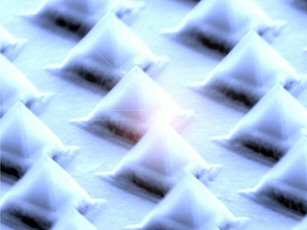
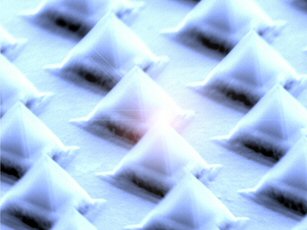
The researchers tested their new machine on 2-micron-high pyramidal quantum dots (pictured). When the electron beam impacts the pyramid, the electrons diffuse towards the closest nanostructure. The diffusion continues until the point of lowest energy is reached - the quantum dot at the tip of the pyramid.

As well as giving us a glimpse into nanoscale dynamics, the new gizmo will allow scientists to explore the properties of previously intractable semiconductor materials. "The wide energy range of the electrons in the beam can excite materials that won't luminesce with laser techniques," explained Deveaud-Pledran. "With a laser, you can't get a short enough wavelength to excite diamond or silicon, for example. This machine will."

"As far as the nanoworld is concerned, we still don't understand the dynamics of materials at the nanoscale. I can't tell you exactly what this machine will lead to because that depends on who uses it and what we find. But there's no question that it will help us make progress, and that the potential applications are exciting," Deveaud-Pledran concluded.

Source: Ecole Polytechnique Federale de Lausanne
Pic courtesy Ecole Polytechnique Federale de Lausanne


Home   |   News   |   Discussion Forum   |   Books   |   Curiosity Shop   |   About
The terms and conditions governing your use of this website.
Copyright © 1997 - 2008 Science a Go Go and its licensors. All rights reserved.