

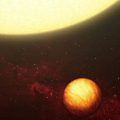
The latest issue of the journal Optical Letters carries an intriguing article about a new optical device that might allow astronomers to view extrasolar planets directly, without the distracting and concealing glare of the parent star. This would be accomplished by “nulling” out the light of the parent star by exploiting its wave nature, while leaving the light reflected from the nearby planet unchanged. The device, being developed by scientists from the University of Arizona (UA), is called an optical vortex coronagraph.
The current method for detecting extrasolar planets relies on detecting a tiny “wobble” in a star’s spectrum of light that indicates gravitational perturbations, possibly created by a planet orbiting the star. This method has been used to identify more than 100 possible extrasolar planets over the last decade.
But that may be about to change. The approach taken by UA optical scientist Grover Swartzlander and his colleagues is to eliminate the star’s light by sending it through a special helical-shaped mask, a sort of lens whose geometry resembles that of a spiral staircase turned on its side. Light passing through the thicker central part of the mask is slowed down and because of the graduated shape of the glass, an “optical vortex” is created. The light coming along the axis of the mask is, in effect, spun out of the image, in effect nulling it out. The researchers say it is as if an opaque mask had been placed across the image of the star, but one that leaves the light from the nearby planet unaffected.
Concepts for an optical vortex have been bandied about for some time, but it has never been applied to astronomy before. In lab trials of the optical vortex mask, light from mock stars has been reduced by factors of 100 to 1000, while light from a nearby mock “planet” was unaffected.
The optical vortex is a more practical technique than merely attempting to cover over the star’s image, as is done in coronagraphs which simply mask out the disk of the sun. The vortex could fully come into its own on a project like the Terrestrial Planet Finder, a proposed orbiting telescope designed to image extrasolar planets.






Comments are closed.