
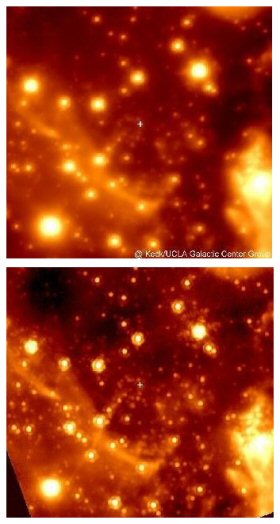
A new adaptive optics system has allowed University of California – Los Angeles (UCLA) astronomers to capture the first clear pictures of the center of our galaxy, including the area believed to harbor a super-massive black hole. The new system allows the Keck telescope in Hawaii to “see” clearly through the distorting effects of the Earth’s atmosphere. “Everything is much clearer now,” said UCLA astronomer Andrea Ghez. “We used a laser to improve the telescope’s vision – a spectacular breakthrough that will help us understand the black hole’s environment and physics. It’s like getting Lasik surgery for the eyes, and will revolutionize what we can do in astronomy.”
Using the new system, the scientists have captured images of the center of the galaxy, targeting the super-massive black hole 26,000 light years away (in the center of the before-and-after images). This approach allowed them to study the infrared light emanating from very hot material about to be pulled through the black hole’s event horizon. “We are learning the conditions of the infalling material and whether this plays a role in the growth of the super-massive black hole,” Ghez said. “The infrared light varies dramatically from week to week, day to day and even within a single hour.”
Source: University of California – Los Angeles
UCLA Galactic Center Group
Related posts:
 Next-gen adaptive optics produce sharpest ever planetary images
 Unusual carbon-based molecule detected 27,000 light years away
 Astronomers witness mysterious disintegration of asteroid
 Flat lens focuses without distortion
 Scientists detect gravitational waves for the second time
 New Method To Find Extrasolar Planets










Comments are closed.