Home   |   News   |   Discussion Forum   |   Books   |   Curiosity Shop
Discussion Forum
Recent Posts
Philosophy of Religions--all religions, including,
Revlgking
Today at 07:41 PM
edge of space; plausible
Mike Kremer
Today at 10:05 AM
Zealotry over Global Warming
ImranCan
Today at 07:07 AM
How Reliable are those climate models?????
Canuck
Yesterday at 06:38 PM
Biofuels Starve the Poor
redewenur
Yesterday at 08:00 AM
Artic Ice Free by 2013 !!
samwik
Yesterday at 01:07 AM
Semantics, Etymology, Syntactics, Etc.
samwik
Yesterday at 12:10 AM
Humanzee? Ape Human Cross
Ellis
05/09/08 11:43 PM
The Mystery of Global Warming's Missing Heat
Mike Kremer
05/09/08 04:12 PM
Einstein...
xumpman
05/09/08 11:40 AM
Hot Topics

The Environment

Evolution

Space

Mind/Brain

Electronics

Climate Change


Sponsored Links
Most Read
Hormones Gone Wild
Homo Superior
The Universe As Magic Roundabout
In Space, No One Can Hear You Say "Doh!"
Bow To Your Insect Overlords!
Bionics
Sex And The Schizoid Factor
Delusions And Mental Illness
We Come In Peace – NOT!
Eeew!
Small Penis Syndrome A Big Problem?
Have You Hugged Your Robot Today?
Down On The Farm - Yields, Nutrients And Soil Quality
Cat Parasite Has Global Ambitions
POP Goes The Planet
The Disappearing Male
Missing Link A Tripping Chimp?
Inorganic Dust Formations Alive?
Science Shopping
Sci Shop
Peculiar scientific stuff that you didn't even know existed and you don't need.
News And Research

Physics

Climate Change

Space

Natural World

Health

Technology


All 2008 News

Rusty's Reading List
Sci Books
Join Rusty Rockets for the lowdown on what you should be reading.
Search
Google

Science a GoGo Web
Archives
2008 2007
2006 2005 2004
2003 2002 2001
2000 1999 1998
Discussions
Features


12 December 2005
Dark Matter Takes Shape With New Map
by Kate Melville

The latest issue of Astrophysical Journal carries news of new "dark matter maps" of two young galaxies created by astrophysicists at Johns Hopkins University.

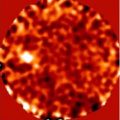
Although scientists can measure the effects of invisible dark matter, its exact nature continues to be elusive. Past attempts to map dark matter in detail with ground-based telescopes have been fruitless. "Observing through the atmosphere is like trying to see the details of a picture at the bottom of a swimming pool full of waves," said Holland Ford, one of the paper's co-authors. Ford and his co-researchers overcame this atmospheric obstacle through the use of the space-based Hubble telescope, from which they gathered images of two galaxy clusters (each containing more than 400 galaxies) in the southern sky. The two clusters of galaxies are relatively young, forming when the universe was about half its present age. The research team measured the subtle gravitational "lensing" apparent in the Hubble images - small distortions of galaxies' shapes caused by gravity from unseen dark matter - to feed into a computer simulation that produced the detailed dark matter maps.

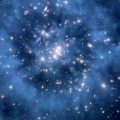
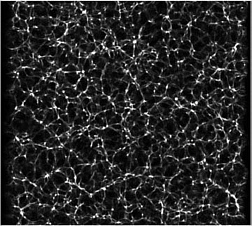
Researcher Myungkook James Jee said the maps provide evidence supporting the theory that the galaxies we can see form at the densest regions of "cosmic webs" of invisible dark matter, just as froth gathers on top of ocean waves. "The images we took show clearly that the cluster galaxies are located at the densest regions of the dark matter haloes, which are rendered in purple in our images." The clumped structure of dark matter around the cluster galaxies is consistent with the current belief that dark matter particles are "collision-less," Jee explained. Physicists speculate that unlike normal matter particles, they do not collide and scatter like billiard balls but rather simply pass through each other.

"Collision-less particles do not bombard one another, the way two hydrogen atoms do. If dark matter particles were collisional, we would observe a much smoother distribution of dark matter, without any small-scale clumpy structures," Jee explained.

The new findings support the theory that dark matter - which accounts for 90 percent of the matter in the universe - and visible matter should coalesce at the same places because gravity pulls them together. Concentrations of dark matter should attract visible matter, and as a result, assist in the formation of luminous stars, galaxies and galaxy clusters.

Some dark matter map images for your edification.
Source: Johns Hopkins University
Pic courtesy Johns Hopkins University


Home   |   News   |   Discussion Forum   |   Books   |   Curiosity Shop   |   About
The terms and conditions governing your use of this website.
Copyright © 1997 - 2008 Science a Go Go and its licensors. All rights reserved.