
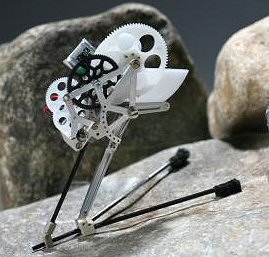
Designed to explore rough, inaccessible terrain or to aid in search and rescue operations, researchers from the Laboratory of Intelligent Systems at Ecole Polytechnique Fédérale de Lausanne (EPFL) have unveiled a novel, grasshopper-inspired jumping robot at the IEEE International Conference on Robotics and Automation in Pasadena, California. The robot weighs a miniscule 7 grams, and can jump 1.4 meters – more than 27 times its body size.
The researchers say the tiny machines could be fitted out with sensors to explore rough, inaccessible terrain or to aid in search and rescue operations. “This biomimetic form of jumping is unique because it allows micro-robots to travel over many types of rough terrain where no other walking or wheeled robot could go,” explains EPFL’s Dario Floreano. “These tiny jumping robots could be fitted with solar cells to recharge between jumps and deployed in swarms for extended exploration of remote areas on Earth or on other planets.”
Related:
Designed By Mother Nature
Novel Robot Will Be “Dynamic And Graceful,” Says Prof
Artificial Eye Borrows From Nature
Super Strong Artificial Muscles Could Power Next Generation Of Robots
Source: Ecole Polytechnique Fédérale de Lausanne
Related posts:
 To Boldly Go Where No Rock Lobster Has Gone Before
 Robots get micro-tentacles to handle delicate objects
 Largest ever self-organizing swarm of robots created
 New Research Center Aims To Plagiarize Nature
 Robot “Skin” Vital For Automated Space Exploration
 High Quality Meteor Spectrum Caught By Chance










Comments are closed.