
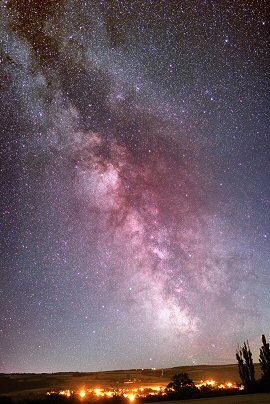
A new computer model of our solar system’s movement relative to the Milky Way indicates that it “bounces” up and down through the plane of the galaxy; a cycle that scientists say is a “beautiful match” with the mass extinction events that occur periodically on Earth.
Writing in the Monthly Notices of the Royal Astronomical Society, the scientists at the Cardiff Centre for Astrobiology that built the computer model say that during certain periods in the bounce, gravitational forces from surrounding gas and dust clouds could dislodge comets from their paths. These comets could then plunge into our solar system, some of them colliding with the Earth.
Napier contends that the periods of comet bombardment also coincide with mass extinctions, such as that of the dinosaurs 65 million years ago. But while the bounce effect may have been bad news for dinosaurs, it may also have helped life to spread. The scientists suggest the impact may have thrown debris containing micro-organisms out into space and across the universe.
“This is a seminal paper which places the comet-life interaction on a firm basis, and shows a mechanism by which life can be dispersed on a galactic scale,” commented Centre director Professor Chandra Wickramasinghe. And in case you’re interested in when the next comet infestation might occur, our present position in the galaxy suggests we are now very close to another such period.
Related:
Did The Age Of Dinosaurs Began With A Comet Impact
“Hot” Comets The Source Of Life?
Tempel’s Spectra Indicate Organic Compounds And Water
Could Tempel 1 Harbor The Seeds Of Life?
Comets May Spread Life From Earth Around Galaxy
Source: Cardiff University
Pic courtesy Jon Lomberg
Related posts:
 Comet smash simulations hint at life’s cosmic origins
 Nomad planets seeding life throughout the universe?
 Discoverer of alien bacteria says life probably exists “everywhere”
 DNA Precursors In Meteorite Confirmed As Extraterrestrial
 Meteorites Spiced Up Primordial Soup
 “Hot” Comets The Source Of Life?



Comments are closed.