Home   |   News   |   Discussion Forum   |   Books   |   Curiosity Shop
Discussion Forum
Recent Posts
Human Influence on Climate
Canuck
Yesterday at 08:27 PM
D.O.E. 30 billion loan guarantee program
paul
Yesterday at 06:14 PM
Bush BLM flip flops back to sanity
paul
Yesterday at 04:56 PM
The Big Crunch will happen after an infinite time
Adib Ben Jebara
Yesterday at 04:42 PM
Universe'sExpansion Non-uniform?
Mike Kremer
Yesterday at 04:22 PM
Type I civilization: can we make it?
Anonymous
07/02/08 11:30 PM
BioFuel Crops are a Crime
Ellis
07/02/08 08:35 PM
Philosophy of Religions--all religions, including,
Revlgking
07/02/08 01:06 PM
CFL - tempers in the house of (representatives ? )
paul
07/02/08 12:44 PM
Aether Wave Theory
redewenur
07/01/08 09:13 PM
Hot Topics

The Environment

Evolution

Space

Mind/Brain

Electronics

Climate Change


Search
Custom Search
Sponsored Links
Most Read
Hormones Gone Wild
Homo Superior
The Universe As Magic Roundabout
In Space, No One Can Hear You Say "Doh!"
Bow To Your Insect Overlords!
Bionics
Sex And The Schizoid Factor
Delusions And Mental Illness
We Come In Peace – NOT!
Eeew!
Small Penis Syndrome A Big Problem?
Have You Hugged Your Robot Today?
Down On The Farm - Yields, Nutrients And Soil Quality
Cat Parasite Has Global Ambitions
POP Goes The Planet
The Disappearing Male
Missing Link A Tripping Chimp?
Inorganic Dust Formations Alive?
Science Shopping
Sci Shop
Peculiar scientific stuff that you didn't even know existed and you don't need.
News And Research

Physics

Climate Change

Space

Natural World

Health

Technology


All 2008 News

Rusty's Reading List
Sci Books
Join Rusty Rockets for the lowdown on what you should be reading.
Archives
2008 2007
2006 2005 2004
2003 2002 2001
2000 1999 1998
Discussions
Features


7 September 2005
Tempel’s Spectra Indicate Organic Compounds And Water
by Kate Melville

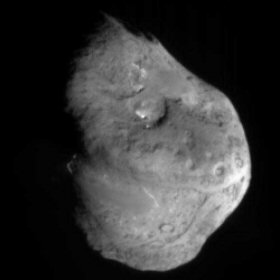
Tempel 1 five minutes before Deep Impact's probe hit its surface. Smooth regions with no features (lower left and upper right) are probably younger than rougher areas with circular features, which are most likely impact craters. The probe crashed between the two dark-rimmed craters near the center and bottom of the comet.
The detailed analysis of the spectral data from Deep Impact's collision with the comet Tempel 1 is now starting to pay dividends. "Prior to our Deep Impact experiment, scientists had a lot of questions and untested ideas about the structure and composition of the nucleus, or solid body of a comet, but we had almost no real knowledge," said Deep Impact principal investigator Dr. Michael A'Hearn. "Our analysis of data produced by Deep Impact is revealing a great deal, much of it rather surprising."

It appears that Tempel 1 has a very fluffy structure that the investigative team says is weaker than a bank of powder snow. While the gravity is extremely weak, it manages to hold the fine dust of the comet together. More surprising was evidence of what appear to be impact craters on the surface of the comet. Previous observations of two other comets showed no evidence of impact craters. "Tempel 1 has… features that satisfy all the criteria for impact craters, including varying size," A'Hearn said. "The problem in stating with certainty that these are impact craters is that we don't know of a mechanism by which some comets would collide with the flotsam and jetsam in our solar system, while others would not."

But the most interesting finding is the huge increase in carbon-containing molecules detected in the ejection plume created by the collision. This suggests that comets contain a substantial amount of organic material. The researchers also saw emission bands for water vaporized by the heat of the impact, followed a few seconds later by absorption bands from ice particles ejected from below the surface. This reinforces the idea of comets as 'dirty snowballs' - containing water and organic compounds, that under the right conditions, could act as the seeds of life. It's possible that comets could have brought those seeds to Earth early in the planet's history, when strikes by asteroids and meteors were common.

Other findings revealed intimate details of how the comet is affected by the sun's heat. "The infrared spectrometer gave us the first temperature map of a comet, allowing us to measure the surface's thermal inertia, or ability to conduct heat to the interior," said researcher Dr. Olivier Groussin. It seems that the comet interior is well shielded from the solar heating experienced by the surface of the comet nucleus. He added that the nucleus of Tempel 1 is extremely porous and its porosity allows the surface of the nucleus to heat up and cool down almost instantly in response to sunlight. This means that heat is not easily conducted to the interior so the ice and other material deep inside the nucleus may be pristine and unchanged from the early days of the solar system.

More information: www.nasa.gov/deepimpact

Source: Media release - NASA


Home   |   News   |   Discussion Forum   |   Books   |   Curiosity Shop   |   About
The terms and conditions governing your use of this website.
Copyright © 1997 - 2008 Science a Go Go and its licensors. All rights reserved.