
30 June 2005
Could Tempel 1 Harbor The Seeds Of Life?
By Rusty Rockets
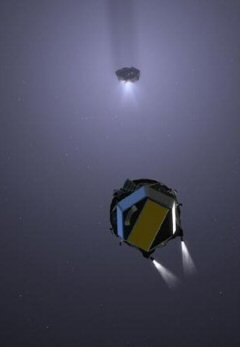 As the July 4 tryst between NASA's Deep Impact spacecraft and the comet Tempel 1 draws closer, it might be time to draw breath and consider just what may dwell beneath the comet's craggy and gaseous surface. Scientists know next to nothing about the composition of a comet's nucleus, which is why they are so keen to capture images and analyze the post-collision particles and debris. If the mission is successful the results could shine a whole new light on the hotly debated topic of panspermia.
As something of a preview, the recent images captured by Hubble of Tempel 1 show a rare and spectacular flare-up that no doubt comes as a welcome sign to many astronomers. "Outbursts such as this may be a very common phenomenon on many comets, but they are rarely observed in sufficient detail to understand them because it is normally so difficult to obtain enough time on telescopes to discover such phenomena," said University of Maryland astronomer Michael A'Hearn, who leads the Deep Impact mission. "With the information we receive after the impact, it will be a whole new ballgame. We know so little about the structure of cometary nuclei that almost every moment we expect to learn something new."
Make no mistake, the Deep Impact mission may change the way scientists look at, not only comets themselves, but how life is dispersed across the universe. Panspermia, the idea that comets (and other wanderers in space) may be carriers of organic matter and the seeds of life, could be supported by the findings from the Deep Impact mission. Since at this stage nobody can truly claim to be an expert, here are a few ideas to consider. What if the comet is a form of communication left over from a civilization now long gone? The "message" traveling on the comet does not even have to be a sophisticated piece of technology; it could be the DNA of a life-form. This isn't as crazy as it sounds and many highly regarded scientists from various fields have been working on conceptualizing how such non-conventional communication might work. Christopher Rose and�Gregory Wright argued in a paper published in Nature that tangible, physical objects are far better for interstellar communications than using radio signals that need to be constantly repeated and then eventually dissipate over long distances anyway. So what about Tempel 1 and comets in general as messaging devices? "Comets are one of my favorite vehicles for posting a message, even if they might be unlikely for the sorts of messaging I have in mind.� I like the out-gassing of material that could be used as a local delivery service only in an inner solar system [heat sensitive release] and I like the fact that the associated coma calls attention to comets [advertisement of the message]," Dr Rose told Science a GoGo.
Rose and Wright consider it unlikely that communication exchanges between civilizations would ever be a synchronized affair, given the vast chasms of time, space and the likely varying technical sophistication between civilizations. "If you took, say, 10 million years to reach a destination [10,000 light years at a thousandth the speed of light] you'd probably want your message to hang around a while - maybe long enough for the local denizens to become sophisticated enough to come get the message," said Rose. And this is one of the major flaws in the concept of a comet being a delivery system. "Comets have one annoying flaw from a messaging perspective - their orbits are not very stable and decay after a few tens of thousands of years."
 Rose also contemplates why a civilization would want to make contact in the first place. He believes it's a case of simple self-preservation. It's certainly possible that if humanity were ever facing annihilation we might want to consider sending out our own DNA, with a suitable "broth" of organic chemicals in the hope that it would replicate our evolutionary journey elsewhere. "If civilizations at any given stellar location are short-lived owing to various sorts of celestial or self-inflicted calamity, there could be a survival benefit to seeding the cosmos with compelling records of a civilization in the hopes that it would be eventually adopted by other fledgling civilizations [or subsumed by older ones]. Perhaps most plausible in this context is literal biological seeding of likely habitats. Under such assumptions, communicating civilizations may more likely have been spawned [or influenced] by older communicating civilizations at other locations while non-communicating civilizations may more likely disappear," said Rose, in a supplementary paper to the original one published in Nature.
Most scientists have not embraced the concept of life on Earth being seeded from space, and though plausible, it's generally regarded as a far-fetched theory. The inhospitable environment of space is one of the stumbling blocks to wider acceptance. Rose told Science a GoGo that "if the 'message' were biological seeding, then maybe the outgassing which forms the coma would be sufficient to deposit sufficient material in a hospitable place - though I've not done the calculation and so have doubts about the viability of such a method."
Fred Hoyle and Chandra Wickramasinghe, both proponents of the panspermia idea, believed living entities like bacteria and viruses are in abundance in space, and that this is how Earth was seeded. "I take the view that all the genes that we have were already here, and the event that added them to the Earth was 570 million years ago. You know, the beginning of the Cambrian, that great event. And that everything that we have subsequently used has been simply a question of permuting and combining what came in at that time," said Hoyle in a 1996 interview. Wickramasinghe told Science a GoGo that he looked "forward to seeing the results [of the Deep Impact mission] with bated breath. I would expect to find more evidence of organic dust and also of a burnt outer asphalt-like crust. While all this will not prove comets as biological niches, it would show that it is entirely possible."
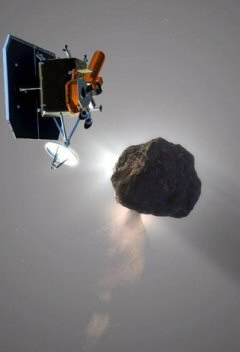
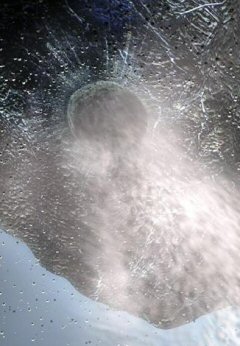 According to NASA, the mission has just entered the "encounter phase", five days before the impact with comet Tempel 1, so it's unlikely the ground crew coordinating the Deep Impact rendezvous will be thinking too much about concepts like panspermia. The impact will occur at staggeringly high speeds, Tempel 1 is traveling at 66,880 miles per hour compared with the impactor spacecraft's 48,990 miles per hour. The impactor craft launched from Deep Impact itself will be automated, because the sheer speed of events creates too great a communications lag between it and ground control. The impactor craft will, during its 24 hours of free flight, travel over half a million miles and maneuver itself directly into the path of the comet. The impactor will execute up to three thruster firings to fine-tune its flight path as it closes in on the comet nucleus. The first is scheduled 90 minutes before impact, followed by a second one 35 minutes before impact and a final firing 12.5 minutes before impact. The countdown is on and looks to be a nail biter.
Source: Media release - University of Maryland, College Park
Media release - NASA
Panspermia.org - Fred Hoyle Interview
Pics (artist's impressions) courtesy NASA