
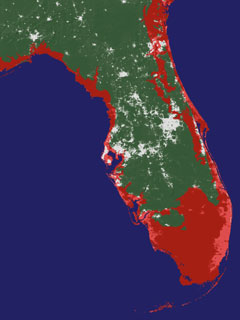
Just when you thought the news about climate change couldn’t get any worse, new projections suggest that the warming climate could melt the Greenland and Antarctic ice sheets much sooner than previously thought, leading to a global sea level rise of at least 20 feet. The scientists behind the new research warn that if the current warming trend continues, the Earth will likely be at least 4 degrees Fahrenheit warmer by 2100. The last time this sort of temperature rise occurred was around 130,000 years ago, when the polar ice caps were much smaller and sea levels were about 20 feet higher than those today.
The scientists used a computer model to predict future climate and combined it with ice sheet simulations to estimate what the Earth’s climate was like 129,000 years ago. The researchers also cross-checked the computer’s estimate of ancient climate against data from natural recorders of ancient climate, such as sediments, fossils and ice cores.
“This is a real eye-opener set of results,” said researcher Jonathan T. Overpeck of The University of Arizona. “The last time the Arctic was significantly warmer than present day, the Greenland Ice Sheet melted back the equivalent of two to three meters (6 to 10 feet) of sea level.” Contrary to what was previously believed, the research suggests the Antarctic ice sheet also melted substantially, contributing another six to 10 feet of sea level rise. Overpeck hypothesizes that Antarctic melting must have produced the additional sea-level rise. He believes it may have been triggered by melting in the Arctic that could have destabilized parts of the Antarctic ice sheet.
In the last few years sea level has begun rising more rapidly and unlike the Greenland Ice Sheet, the base of the West Antarctic Ice Sheet is below sea level. If it starts to melt, it could go fast, explains Overpeck. Moreover, during the Last Interglaciation, most of the warming was in the Arctic and only in summer. Now the Earth is warming at both poles year round. “To get rid of Greenland’s ice, you have to melt it. In the Antarctic, all you have to do is break up the ice sheet and float it away and that would raise sea level,” he said. “It’s just like throwing a bunch of ice cubes into a full glass of water and watching the water spill over the top.”
“Although the focus of our work is polar, the implications are global. These ice sheets melted before and sea levels rose. The warmth needed isn’t that much above present conditions,” added co-researcher Co-author Bette Otto-Bliesner, of the National Center for Atmospheric Research.
“Although ice sheet disintegration and the subsequent sea level rise lags behind rising temperatures, the process will become irreversible sometime in the second half of the 21st century unless something is done to dramatically reduce human emissions of greenhouse gas pollution,” Overpeck concluded. “We need to start serious measures to reduce greenhouse gases within the next decade. If we don’t do something soon, we’re committed to four-to-six meters (13 to 20 feet) of sea level rise in the future.”














Comments are closed.