
Atmospheric scientists from Georgia Tech have reported that emissions from phytoplankton can dramatically alter cloud formation over oceans, adding a new and important variable into the climate change equation.
Reporting their findings in Science Express, the researchers admitted they stumbled upon the phytoplankton-cloud connection accidentally. “While looking at satellite pictures, I noticed that cloud properties over large phytoplankton blooms were significantly different from those that occurred away from the blooms,” recalled Nicholas Meskhidze.
Based on satellite data, the researchers hypothesized that airborne particles produced by oxidation of the chemical isoprene – which is emitted by the phytoplankton – may have contributed to a doubling of cloud droplet concentrations seen over a large area of ocean off the eastern coast of South America.
The Southern Ocean normally has relatively few particles around which cloud droplets can form. The isoprene mechanism could therefore have a significant effect on the development of clouds there – and may account for most of variation in the area’s cloud cover.
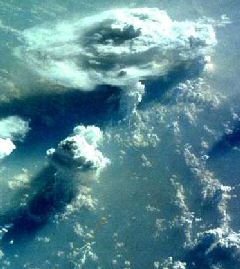
“If a lot of particles form because of isoprene oxidation, you suddenly have a lot more droplets in clouds, which tends to make them brighter,” co-researcher Athanasios Nenes explained. “In addition to becoming brighter, the clouds can also have less frequent precipitation, so you might have a build-up of clouds. Overall, this makes the atmosphere cloudier and reflects more sunlight back into space.”
Other studies have suggested that dimethyl sulfide (DMS) – which is also emitted by phytoplankton – affects the formation of clouds by increasing the number of sulfate particles, which can absorb moisture and form cloud droplets. “Isoprene may enhance the effect of DMS by increasing the number and size of the particles while helping them to chemically attract more moisture. The impact of isoprene on atmospheric particulate matter was previously thought to be important only for terrestrial plants,” Nenes said.
“One of the largest uncertainties right now in climate models is the ability to predict how clouds would respond to changing particle levels – whether they originate from humans with air pollution or from biological activity. We can now see very strongly the influence of marine biology on oceanic clouds,” Nenes said. As a next step, he would like to examine other areas of the globe for similar activity. “There are a lot of areas that have intense biological activity, so with time we are going to explore more regions to see if this is a widespread phenomenon. Chances are that we will see this in other places,” he concluded.
Related Articles
UV Light Turns Plankton Into Cloud Factories
Swimming Critters Add New Variable To Climate Confusion
Icebergs’ Impact On Antarctic Marine Life Devastating
World’s Oceans Becoming More Acidic
Source: Georgia Institute of Technology Research News