Home   |   News   |   Discussion Forum   |   Books   |   Curiosity Shop
Discussion Forum
Recent Posts
The platypus genome sequenced
redewenur
12:55 AM
Philosophy of Religions--all religions, including,
Anonymous
12:38 AM
edge of space; plausible
Mike Kremer
10:05 AM
Zealotry over Global Warming
ImranCan
07:07 AM
How Reliable are those climate models?????
Canuck
05/10/08 06:38 PM
Biofuels Starve the Poor
redewenur
05/10/08 08:00 AM
Artic Ice Free by 2013 !!
samwik
05/10/08 01:07 AM
Semantics, Etymology, Syntactics, Etc.
samwik
05/10/08 12:10 AM
Humanzee? Ape Human Cross
Ellis
05/09/08 11:43 PM
The Mystery of Global Warming's Missing Heat
Mike Kremer
05/09/08 04:12 PM
Hot Topics

The Environment

Evolution

Space

Mind/Brain

Electronics

Climate Change


Sponsored Links
Most Read
Hormones Gone Wild
Homo Superior
The Universe As Magic Roundabout
In Space, No One Can Hear You Say "Doh!"
Bow To Your Insect Overlords!
Bionics
Sex And The Schizoid Factor
Delusions And Mental Illness
We Come In Peace – NOT!
Eeew!
Small Penis Syndrome A Big Problem?
Have You Hugged Your Robot Today?
Down On The Farm - Yields, Nutrients And Soil Quality
Cat Parasite Has Global Ambitions
POP Goes The Planet
The Disappearing Male
Missing Link A Tripping Chimp?
Inorganic Dust Formations Alive?
Science Shopping
Sci Shop
Peculiar scientific stuff that you didn't even know existed and you don't need.
News And Research

Physics

Climate Change

Space

Natural World

Health

Technology


All 2008 News

Rusty's Reading List
Sci Books
Join Rusty Rockets for the lowdown on what you should be reading.
Search
Google

Science a GoGo Web
Archives
2008 2007
2006 2005 2004
2003 2002 2001
2000 1999 1998
Discussions
Features


23 March 2006
Increasing Soil Erosion Threatens World’s Food Supply
by Kate Melville

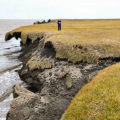
An ecologist from Cornell University reports that soil from the world's croplands is being swept and washed away 10 - 40 times faster than it is being replenished. Astonishingly, an agricultural area the size of Indiana is destroyed every year.

Cornell's David Pimentel lamented that while climate change hogged the headlines, nobody cared much about soil erosion. "Soil erosion is second only to population growth as the biggest environmental problem the world faces," he said. "Yet, the problem, which is growing ever more critical, is being ignored, because who gets excited about dirt?"

People should start getting concerned now, according to Pimentel, particularly with demand for food and other agricultural products continuing to soar. His figures indicate that the United States is losing soil 10 times faster than the natural replenishment rate, while China and India are losing soil 30 - 40 times faster. Pimentel says that as a result of erosion over the past 40 years, 30 percent of the world's arable land has become unproductive.

His study, appearing in the Journal of the Environment, Development and Sustainability, noted that erosion does not only impact arable land. Around 60 percent of eroded soil ends up in rivers, streams and lakes, making waterways more prone to flooding and to contamination from fertilizers and pesticides. Erosion also reduces the ability of the soil to store water and support plant growth, thereby reducing its ability to support biodiversity.

"Erosion is a slow and insidious process that nickels and dimes you to death. One rainstorm can wash away 1 mm of dirt. It doesn't sound like much, but when you consider a hectare, it would take 13 tons of topsoil - or 20 years if left to natural processes - to replace that loss," Pimentel explained. "And that kind of loss occurs year after year by wind and rain around the world."

But stopping soil erosion is easy, he said. "Controlling soil erosion is really quite simple. The soil can be protected with cover crops when the land is not being used to grow crops." Other ways he cited to lessen erosion include reducing the need for people in developing countries to clear forests for agriculture, overgraze their cattle and remove crop residues for cooking fuel.

Source: Cornell University



Home   |   News   |   Discussion Forum   |   Books   |   Curiosity Shop   |   About
The terms and conditions governing your use of this website.
Copyright © 1997 - 2008 Science a Go Go and its licensors. All rights reserved.