
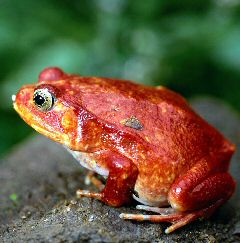
Amphibian species are under unprecedented assault and are experiencing tens of thousands of years worth of extinctions in just a century, according to a new study which examined the status of all 5,743 known amphibian species. The researchers say that around a third of all amphibian species are now threatened with extinction. Scientists from more than 60 nations contributed to the Global Amphibian Assessment, to be published in the journal Science.
Amphibians are widely regarded as “canaries in the coal mine,” since their highly permeable skin is more immediately sensitive to changes in the environment, including changes to freshwater and air quality. “Amphibians are one of nature’s best indicators of overall environmental health,” said Russell A. Mittermeier, president of Conservation International (CI). “Their catastrophic decline serves as a warning that we are in a period of significant environmental degradation.”
The study’s key findings include:
- According to the IUCN Red List of Threatened Species, at least 1,856 amphibian species are threatened with extinction, representing 32 percent of all species. By comparison, only 12 percent of all bird species and 23 percent of all mammal species are threatened.
- At least nine species have gone extinct since 1980, when the most dramatic declines began. Another 113 species have not been reported from the wild in recent years and are considered to be possibly extinct.
- 43 percent of all species are in population decline; fewer than one percent are increasing. Twenty seven percent are stable, and the rest are unknown.
- 427 species are considered Critically Endangered (CR), 761 are Endangered (EN), and 668 are Vulnerable (VU).
- Colombia has 208 threatened amphibian species – the most in the world – followed by Mexico with 191, Ecuador with 163, Brazil with 110, and China with 86. Haiti has the highest percentage of threatened amphibians, with 92 percent of its species at risk of extinction.
“This study significantly expands our current knowledge and provides a baseline from which we can monitor our impact on the environment over time,” said Achim Steiner, Director General of IUCN-The World Conservation Union. “The fact that one third of amphibians are in a precipitous decline tells us that we are rapidly moving towards a potentially epidemic number of extinctions.”
In the Americas, the Caribbean and Australia, a highly infectious disease called chytridiomycosis has hit amphibians especially hard. New research is showing that in some regions, outbreaks of the disease may be linked to drought years, which scientists are increasingly attributing to the effects of climate change. But in most parts of the world – including Europe, Asia and Africa – chytridiomycosis is currently less of a problem. Other threats, such as habitat destruction, air and water pollution and consumer demand are leading causes of amphibian decline.
“Since most amphibians depend on freshwater and feel the effects of pollution before many other forms of life, including humans, their rapid decline tells us that one of Earth’s most critical life support systems is breaking down,” said lead researcher Simon Stuart.








Comments are closed.