
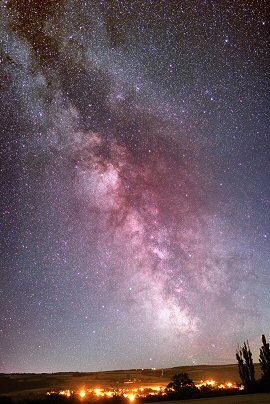
An analysis of the spectral emissions from distant stars suggests that compounds of unexpected complexity – some resembling coal and petroleum – exist throughout the universe and are being made by stars. The proponents of this controversial idea, Professors Sun Kwok and Yong Zhang of the University of Hong Kong, argue their case in the current issue of the journalNature.
Kwok and Zhang base their hypothesis on a set of infrared emissions – known as “Unidentified Infrared Emission Features” – previously detected in stars and interstellar space. Since the first recording of these emissions, the most commonly accepted theory regarding their origin has been that they come from simple organic molecules made of carbon and hydrogen atoms, known as polycyclic aromatic hydrocarbons (PAH).
Kwok and Zhang contend, however, that observations from the Infrared Space Observatory and the Spitzer Space Telescope indicate that these spectra have features that cannot be explained by PAH molecules alone. Rather, they propose that the substances generating these spectra have chemical structures that are much more complex. By analyzing the emissions of star dust formed in exploding stars, they claim that stars are making these complex organic compounds in timeframes of only weeks.
The scientists add that not only are stars producing this complex organic matter, they are also ejecting it into interstellar space. “Our work has shown that stars have no problem making complex organic compounds under near-vacuum conditions,” said Kwok. “Theoretically, this is impossible, but observationally we can see it happening.”
Kwok and Zhang’s work raises the possibility that stars enriched the early solar system with complex organic compounds. The early Earth was subjected to bombardment by comets and asteroids, which may have been delivery vehicles for this organic star dust. Whether these organic compounds played any role in the development of life on Earth remains an open question.
Related:
Discuss this article in our forum
DNA Precursors In Meteorite Confirmed As Extraterrestrial
Discoverer of alien bacteria says life probably exists “everywhere”
More evidence for asteroids creating life on Earth
Discovery of asteroid water hints at oceans’ origins
Organic molecule hints at alien life






Comments are closed.