
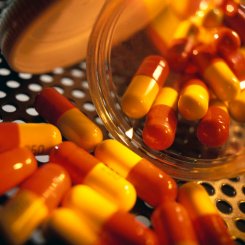
Researchers from the Albert Einstein College of Medicine of Yeshiva University are developing a new generation of antibiotic compounds that work by disrupting bacterial communication, thus avoiding the problem of bacterial resistance. So far, the new compounds have been shown to work against two of the main food contaminant microbes that together cause 110,000 illnesses and 50 deaths in the US each year.
The research team, reporting their work in Nature Chemical Biology, explained that most antibiotics initially work extremely well, killing more than 99.9 percent of the microbes they target. But through mutation and the selection pressure exerted by the antibiotic, a few bacterial cells inevitably manage to survive, repopulate the bacterial community, and flourish as antibiotic-resistant strains.
The new antibiotics work by reducing the infective functions of the bacteria, but not killing them, thus minimizing the risk that resistance will later develop. The main target for the new drugs is “quorum sensing” – the process by which bacteria communicate with each other by producing and detecting signaling molecules known as autoinducers. These autoinducers coordinate bacterial gene expression and regulate processes – including virulence – that benefit the microbial community.
To design such a compound, Schramm’s team first formed a picture of an enzyme’s transition state – the brief (one-tenth of one-trillionth of a second) period in which a substrate is converted to a different chemical at an enzyme’s catalytic site. Schramm and his colleagues tested three transition state analogs against the quorum sensing pathway. All three compounds were highly potent in disrupting quorum sensing in both V. choleraeand the E. coli strain.
To see whether the microbes would develop resistance, the researchers tested the analogs on 26 successive generations of both bacterial species. The 26th generations were as sensitive to the antibiotics as the first. “In our lab, we call these agents everlasting antibiotics,” boasted Schramm.
He notes that many other aggressive bacterial pathogens – S. pneumoniae, N. meningitides, Klebsiella pneumoniae, and Staphylococcus aureus – express MTAN and therefore would probably also be susceptible to these inhibitors. Schramm says that his team has now developed more than 20 potent MTAN inhibitors, all of which are expected to be safe for human use: since MTAN is a bacterial enzyme, blocking it will have no effect on human metabolism.
Related:
Human Gut Breeding Ground For Antibiotic Resistance
Antibiotic Misuse A Serious Concern Say Experts
Prevalence Of Antibiotic Resistance Surprises
Halting Evolution To Fight Illness













Comments are closed.