

Intriguing new evidence of life-like double-helix structures formed from inorganic substances in space has been reported in the New Journal of Physics. The physicists behind the discovery are now pondering whether extraterrestrial life could be composed of corkscrew-shaped formations of interstellar dust. The findings hint at the possibility that life beyond Earth may not necessarily use carbon-based molecules as its building blocks and they may also point to a possible new explanation for the origin of life on Earth.
The idea that particles of inorganic dust can take on a life of their own is nothing short of alien, but an international team has discovered that under the right conditions, particles of inorganic dust can become organized into helical structures.
V.N. Tsytovich of the Russian Academy of Science, working with colleagues there and at the Max-Planck Institute for Extraterrestrial Physics and the University of Sydney, has studied the behavior of complex mixtures of inorganic materials in a plasma. Until now, physicists assumed that there could be little organization in such a cloud of particles.
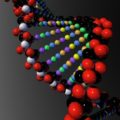
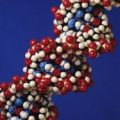
However, using a computer model of molecular dynamics, Tsytovich and his colleagues demonstrated that particles in a plasma can undergo self-organization as electronic charges become separated and the plasma becomes polarized. This effect results in microscopic strands of solid particles that twist into corkscrew shapes, or helical structures resembling DNA. These helical strands are themselves electronically charged and are attracted to each other.
Bizarrely, not only do these helical strands interact in a counterintuitive way in which like can attract like, but they also undergo changes that are normally associated with biological molecules, says Tsytovich. He says they can divide (or bifurcate) to form two copies of the original structure and can also interact to induce changes in their neighbors. They can even evolve into yet more structures as less stable ones break down, leaving behind only the “fittest” structures in the plasma.
Could helical clusters formed from interstellar dust be somehow alive? “These complex, self-organized plasma structures exhibit all the necessary properties to qualify them as candidates for inorganic living matter,” muses Tsytovich, “they are autonomous, they reproduce and they evolve.” He added that the plasma conditions needed to form these helical structures are common in outer space.
Interestingly, plasmas can also form under terrestrial conditions, such as the point of a lightning strike. The researchers speculate that perhaps an inorganic form of life emerged on the primordial earth, which then acted as the template for the more familiar organic molecules we know today.
Related articles:
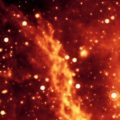
DNA Shaped Nebula Observed At Center Of Milky Way
Meteor Craters The Cradle Of Life?
Terrestrial Gamma Ray Mystery Deepens
DNA Structure Still Surprises
Biochemists Mull Alternative DNA Structures





Comments are closed.