Home   |   News   |   Discussion Forum   |   Books   |   Curiosity Shop
Discussion Forum
Recent Posts
Human Influence on Climate
Mike Kremer
Yesterday at 06:34 PM
Most Influential Sci Fi Movie
Mike Kremer
Yesterday at 05:36 PM
BioFuel Crops are a Crime
Mike Kremer
Yesterday at 04:36 PM
The Big Crunch will happen after an infinite time
odin1
Yesterday at 12:38 PM
Type I civilization: can we make it?
big fat pig
Yesterday at 12:18 PM
Aether Wave Theory
Zephir
Yesterday at 10:40 AM
D.O.E. 30 billion loan guarantee program
paul
07/03/08 06:14 PM
Bush BLM flip flops back to sanity
paul
07/03/08 04:56 PM
Universe'sExpansion Non-uniform?
Mike Kremer
07/03/08 04:22 PM
Philosophy of Religions--all religions, including,
Revlgking
07/02/08 01:06 PM
Hot Topics

The Environment

Evolution

Space

Mind/Brain

Electronics

Climate Change


Search
Custom Search
Sponsored Links
Most Read
Hormones Gone Wild
Homo Superior
The Universe As Magic Roundabout
In Space, No One Can Hear You Say "Doh!"
Bow To Your Insect Overlords!
Bionics
Sex And The Schizoid Factor
Delusions And Mental Illness
We Come In Peace – NOT!
Eeew!
Small Penis Syndrome A Big Problem?
Have You Hugged Your Robot Today?
Down On The Farm - Yields, Nutrients And Soil Quality
Cat Parasite Has Global Ambitions
POP Goes The Planet
The Disappearing Male
Missing Link A Tripping Chimp?
Inorganic Dust Formations Alive?
Science Shopping
Sci Shop
Peculiar scientific stuff that you didn't even know existed and you don't need.
News And Research

Physics

Climate Change

Space

Natural World

Health

Technology


All 2008 News

Rusty's Reading List
Sci Books
Join Rusty Rockets for the lowdown on what you should be reading.
Archives
2008 2007
2006 2005 2004
2003 2002 2001
2000 1999 1998
Discussions
Features


16 March 2006
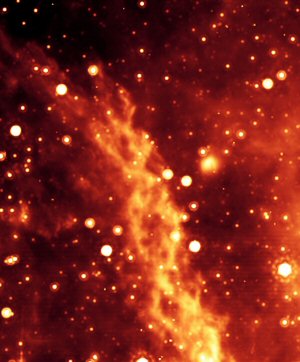
DNA Shaped Nebula Observed At Center Of Milky Way
by Kate Melville

Astronomers using the Spitzer Space Telescope have observed an astonishing double helix shaped nebula near the center of our Milky Way galaxy. The astronomers, writing in Nature, estimate the nebula to be around 80 light years in length and situated only 300 light years away from the massive black hole at the center of the Milky Way.

The DNA shaped nebula stunned the astronomers involved. "We see two intertwining strands wrapped around each other as in a DNA molecule," said Mark Morris, a UCLA professor of astronomy, and lead author of the report. "Nobody has ever seen anything like that before in the cosmic realm. Most nebulae are either spiral galaxies full of stars or formless amorphous conglomerations of dust and gas. What we see indicates a high degree of order."

Morris believes that the magnetic field at our galaxy's center is responsible for the intriguingly shaped nebula. "We know the galactic center has a strong magnetic field that is highly ordered and that the magnetic field lines are oriented perpendicular to the plane of the galaxy," Morris explained. "If you take these magnetic field lines and twist them at their base, that sends what is called a torsional wave up the magnetic field lines. You can regard these magnetic field lines as akin to a taut rubber band. If you twist one end, the twist will travel up the rubber band," he added.

The magnetic field at the center of the Milky Way - although 1,000 times weaker than the magnetic field on the sun - occupies such a large volume of space that it has vastly more energy than the sun's field. Morris believes that all galaxies that have a well-concentrated galactic center may also have a strong magnetic field at their center.

Exactly what creates the torsional wave is still something of a mystery, but Morris doesn't believe the massive black hole at galactic central is the culprit. Orbiting the black hole, several light years away, is a massive disk of gas called the circumnuclear disk which Morris hypothesizes anchors the magnetic field lines. The disk orbits the black hole approximately once every 10,000 years. "Once every 10,000 years is exactly what we need to explain the twisting of the magnetic field lines that we see in the double helix nebula," Morris said.

Source: UCLA
Pic courtesy UCLA


Home   |   News   |   Discussion Forum   |   Books   |   Curiosity Shop   |   About
The terms and conditions governing your use of this website.
Copyright © 1997 - 2008 Science a Go Go and its licensors. All rights reserved.