

A presentation scheduled for a joint meeting of the Geological Society of America and the Geological Association of Canada will explore the idea that the heavy bombardment of Earth by meteors during the planet’s youth actually jump-started early life on the planet.
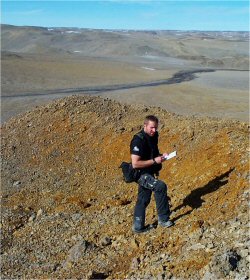
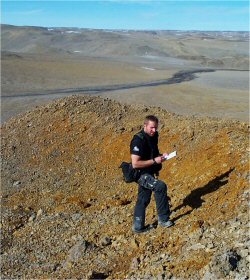
These musings on the beginnings of early life struck Canadian Space Agency geologist Gordon Osinski while he was conducting a survey of the 15 mile diameter Haughton Crater, on Devon Island, in the Canadian Arctic. He and his co-researchers noticed what looked like fossilized hydrothermal pipes (pictured), a few meters in diameter, on the rim of the crater. Hydrothermal systems are thought by many life scientists to be favorable places for life to evolve. “That set the bells ringing about possible biological implications,” said Osinski. As well as possibly creating hydrothermal systems, meteor strikes blast and shatter rocks, making them easier for microbes to inhabit, and the crater itself provides a protected basin. It’s possible that impact craters could represent some of the best sites to look for signs of early life on Mars and other planets say the researchers.
Analysis of the Haughton crater, created 23 million years ago, has shown that the impact fractured the ground in such a way as to create a system of steamy hydrothermal springs reaching temperatures of 250 degrees Celsius. The researchers say that the temperature appears to have gradually cooled over a period of tens of thousands of years. As well as a nice wet, steamy environment, the impact also created pore spaces in otherwise dense granite rocks, giving struggling microbes more access to minerals and the surfaces inside the rocks. Interestingly, impacted rocks are also more translucent, which would be beneficial to organisms that might rely on photosynthesis.
“Most people put impacts with mass extinctions. What we’re trying to say is that following the impact, the impact sites are actually more favorable to life than the surrounding terrain,” said Osinski.
Pic courtesy of Gordon Osinski/Canadian Space Agency






Related posts:
 Space station experiment identifies microbes that can survive unprotected in space
 Camouflage or bright colors? What’s better to live long and prosper?
 Spinning nanoparticles hint at origin of life
 Rethink creation of life in terms of information, argues new theory
 Water not necessary for life?
 Tunguska Revisited