Home   |   News   |   Discussion Forum   |   Books   |   Curiosity Shop
Discussion Forum
Recent Posts
Philosophy of religion: Yours, MIne and Ours...
Tutor Turtle
Today at 11:17 AM
FOR SALE Sony VAIO PCG-GRT100P (PCG-GRT100P44) PC
mack
Today at 09:39 AM
FOR SALE NOKIA N96 16GB AND IPHONE 3G 16GB
mack
Today at 09:37 AM
Aether Wave Theory
Zephir
Today at 02:40 AM
BioFuel Crops are a Crime
Rallem
Yesterday at 02:14 PM
I see now
samwik
09/05/08 12:23 PM
simulation vs. empirical
Anonymous
09/01/08 09:01 AM
Standard Particle Model
Aaron
09/01/08 07:08 AM
What Would We Choose To Do If...
Revlgking
08/31/08 01:59 PM
Energy from Aether : toroidal coils powred with AC
Zephir
08/30/08 06:53 PM
Hot Topics

The Environment

Evolution

Space

Mind/Brain

Electronics

Climate Change


Search
Custom Search
Sponsored Links
Most Read
Hormones gone wild
Homo superior
The universe as magic roundabout
In space, no one can hear you say "doh!"
Bow to your insect overlords!
Bionics
Sex and the schizoid factor
Delusions and mental illness
We come in peace – not!
Eeew!
Small penis syndrome a big problem?
Have you hugged your robot today?
Down on the farm - yields, nutrients and soil quality
Cat parasite has global ambitions
Pop goes the planet
The disappearing male
Missing link a tripping chimp?
Inorganic dust formations alive?
Science Shopping
Sci Shop
Peculiar scientific stuff that you didn't even know existed and you don't need.
News And Research

Physics

Climate Change

Space

Natural World

Health

Technology


All 2008 News

Rusty's Reading List
Sci Books
Join Rusty Rockets for the lowdown on what you should be reading.
Archives
2008 2007
2006 2005 2004
2003 2002 2001
2000 1999 1998
Discussions
Features


5 March 2007
3-D Fabrication Goes Open Source
by Kate Melville

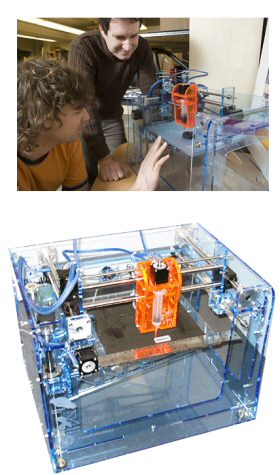
Hod Lipson and Evan Malone of Cornell University have cooked-up a cheap DIY 3-D printer - the Fab@Home - that they believe could lead to the widespread use of fabrication machines by hobbyists and experimenters. Fabrication machines, or fabbers, operate on the same principle as inkjet printers, but instead of squirting out ink onto paper, they squirt plastic or other materials into three-dimensional shapes. Commercial systems average around $100,000, but you can build Cornell's Fab@Home for about US$2,300 worth of off-the-shelf parts.

Although the Fab@Home is slower than commercial models and its resolution is lower, researchers around the world have expressed a great deal of interest in the system. Lipson says that so far, about a dozen people have started building one, and he knows of three that are actually up and running - two at the University of Washington and one in Austria. Anyone can download free plans for the machine from the Fab@Home website. The site also includes construction hints, ideas for applications, notes on the history of 3-D printing and discussion groups.

Undoubtedly, the main attraction of the system is that it is open source, meaning that anyone can enhance and improve the system for the benefit of all users. This is in stark contrast to commercial machines which can't be modified, which, Lipson says, impedes the progress of fabbing.

Because it's still early days for the technology, the kinds of objects being reproduced are non-complex. Lego parts, watchbands and containers are some of the demonstration items shown on the website. But Lipson says that the open source nature of the project will ensure diverse and surprising applications will emerge. He cites how biologists are using the machine to deposit slime mold cells in various arrangements to see how the distribution influences their ability to form colony organisms.

For more complex reproductions, future fabbing machines will have to shift from one raw material to another in midstream. By using multiple nozzles or a means of swapping supply cartridges, the machine could then theoretically create objects made of many different materials. An electronic circuit, for example, could be made by combining an organic semiconductor, metallic inks and ceramic insulators.

To date, the researchers have built a machine that uses a rack of interchangeable cartridges to make devices out of several materials at once. So far, it has made a working battery, complete with outer case. Malone's long-range goal is to "print" a complete robot, including limbs, actuators, control circuitry and batteries.

Related articles:
Cornucopia Machine Not Far Off, Say Brits

Source: Cornell University
Pic courtesy Lindsay France/Cornell University Photography


Home   |   News   |   Discussion Forum   |   Books   |   Curiosity Shop   |   About
The terms and conditions governing your use of this website.
Copyright © 1997 - 2008 Science a Go Go and its licensors. All rights reserved.