Home   |   News   |   Discussion Forum   |   Books   |   Curiosity Shop
Discussion Forum
Recent Posts
The platypus genome sequenced
redewenur
12:55 AM
Philosophy of Religions--all religions, including,
Anonymous
12:38 AM
edge of space; plausible
Mike Kremer
10:05 AM
Zealotry over Global Warming
ImranCan
07:07 AM
How Reliable are those climate models?????
Canuck
05/10/08 06:38 PM
Biofuels Starve the Poor
redewenur
05/10/08 08:00 AM
Artic Ice Free by 2013 !!
samwik
05/10/08 01:07 AM
Semantics, Etymology, Syntactics, Etc.
samwik
05/10/08 12:10 AM
Humanzee? Ape Human Cross
Ellis
05/09/08 11:43 PM
The Mystery of Global Warming's Missing Heat
Mike Kremer
05/09/08 04:12 PM
Hot Topics

The Environment

Evolution

Space

Mind/Brain

Electronics

Climate Change


Sponsored Links
Most Read
Hormones Gone Wild
Homo Superior
The Universe As Magic Roundabout
In Space, No One Can Hear You Say "Doh!"
Bow To Your Insect Overlords!
Bionics
Sex And The Schizoid Factor
Delusions And Mental Illness
We Come In Peace – NOT!
Eeew!
Small Penis Syndrome A Big Problem?
Have You Hugged Your Robot Today?
Down On The Farm - Yields, Nutrients And Soil Quality
Cat Parasite Has Global Ambitions
POP Goes The Planet
The Disappearing Male
Missing Link A Tripping Chimp?
Inorganic Dust Formations Alive?
Science Shopping
Sci Shop
Peculiar scientific stuff that you didn't even know existed and you don't need.
News And Research

Physics

Climate Change

Space

Natural World

Health

Technology


All 2008 News

Rusty's Reading List
Sci Books
Join Rusty Rockets for the lowdown on what you should be reading.
Search
Google

Science a GoGo Web
Archives
2008 2007
2006 2005 2004
2003 2002 2001
2000 1999 1998
Discussions
Features


18 August 2006
Novel Transistor Design Blasts Single Electrons Through Circuits
by Kate Melville

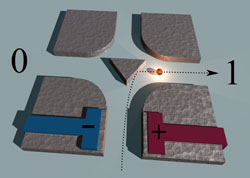
Computer engineers at the University of Rochester have thrown out the rulebook on transistor design and put together a prototype nano-scale transistor that is radically different from any other type of semiconductor. Christened the "Ballistic Deflection Transistor" (BDT), the new device works by bouncing individual electrons off deflectors, something akin to a game of billiards played at the atomic scale at unimaginable speeds.

Rochester's Quentin Diduck, who came up with the radical new design, believes the BDT is the next evolutionary step in semiconductor physics. "Everyone has been trying to make better transistors by modifying current designs, but what we really need is the next paradigm," said Diduck.

Driving the development of the BDT is the quest for more speed and better efficiency. While current transistor designs are still viable, the amount of heat they generate and the electrical "leaks" created by their size have already begun to limit their speed. Some other research groups around the world are working on BDT-like single-electron transistors, but these other designs still compute by starting and stopping the flow of electrons just like conventional transistor designs. The Ballistic Deflection Transistor differs significantly in this functionality, as it works by bouncing the electrons into their chosen trajectories - using inertia to redirect for "free," instead of wrestling the electrons into place with brute energy. This means the BDT produces far less heat and runs far faster than standard transistors.

The BDT resembles a roadway intersection, except in the middle of the intersection sits a triangular block. From the "south" an electron is fired, as it approaches the crossroads, it passes through an electrical field that pushes the electron slightly east or west. When the electron reaches the middle of the intersection, it "bounces" off one side of the triangle block and is deflected straight along either the east or west roads. In this way, if the electron current travels along the east road, it may be counted as a zero, and as a one if it travels down the west road.

Diduck says a chip using BDTs would use very little power, create very little heat, be highly resistant to "noise" inherent in electronic systems, and should be easy to manufacture with current technologies. And they would also be incredibly fast. All of which was good enough for the National Science Foundation to tip in over $1 million in funding to develop a prototype.

The team is now busy fabricating a prototype although much of the infrastructure needed to create the prototype will have to be built from scratch as well. "We're talking about a chip speed measured in terahertz, a thousand times faster than today's desktop transistors" Diduck said. "We have to figure out how to test it because there's no such thing as a terahertz oscilloscope!"

Source: University of Rochester
Pic courtesy University of Rochester


Home   |   News   |   Discussion Forum   |   Books   |   Curiosity Shop   |   About
The terms and conditions governing your use of this website.
Copyright © 1997 - 2008 Science a Go Go and its licensors. All rights reserved.