
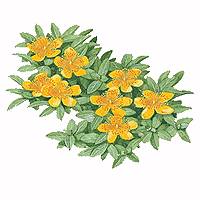
Plant pathologists from Cornell University and the U.S. Department of Agriculture (USDA) have found that hypericin (pronounced hi-PARIS-in), an active ingredient in St. John’s wort (Hypericum perforatum) — a popular herbal remedy for depression– might be increased when the plant is attacked by predators such as insects.
“It appears to increase its own chemical arsenal to ward off attack from predators,” says Donna M. Gibson, a USDA plant physiologist and Cornell adjunct professor of plant pathology. Gibson and Tara M. Sirvent, a Cornell plant pathology graduate student from Casper, Wyo., have developed a way to analyze the active chemical and other related compounds in the plant.
Sirvent and Gibson will present a poster, “Are hypericins involved in plant defense strategies of St. John’s wort?” on Aug. 15 at the annual meeting of the American Phytopathological Society at the Hyatt Regency Hotel in New Orleans. The research was funded by the USDA’s Agricultural Research Service and the agency’s Foreign Agricultural Service.
The researchers dissolved the chemical components of the plant in a solution and separated them using a technique called high-performance liquid chromatography. This enabled the detection of individual compounds in the plant. Sirvent and Gibson examined wild populations and found plants that had been exposed to stress — particularly attacks from insects — had increased amounts of hypericin.
The level of hypericin determines the potency of St. John’s wort sold over-the-counter, and as the plant’s hypericin content increases so does its worth. While much of St. John’s wort sold in stores is “wild-crafted” — or picked from the wild — commercially produced H. perforatum can fetch as much as $2,000 to $3,000 an acre.
Additionally, variations in St. John’s wort products sometimes occur because manufacturers mix species of H. perforatum.
The plant typically is gathered as a weedy species in the western United States, but some is being grown commercially in the Pacific Northwest. It also is found along roadways and in fields in the eastern United States. Hypericin is concentrated in little black nodules — nearly imperceptible to the untrained eye — that adorn the floral edges and the plant’s leaves. Curiously, St. John’s wort is considered a noxious weed that can cause hypericism, or blistering and dyeing of an animal’s skin when it is eaten. Its scraggly, almost frail-looking stem produces a brilliant yellow flower cluster and it grows readily in rock quarries and in marginal areas such as roadsides, where little else grows.
Related posts:
 Scientists mull polarized light detection from alien life-forms
 A genetic basis for love at first sight
 Compelling new evidence for benefits of circumcision
 New antibiotics solve resistance problem
 “Ethanol subsidies a poor investment economically and environmentally,” study finds
 Dire new warning on climate from IPCC scientist





Comments are closed.