
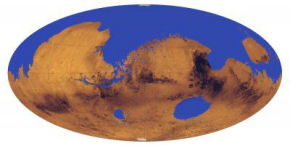
University of Colorado at Boulder scientists have uncovered new evidence for a massive ocean that covered a third of Mars’ surface some 3.5 billion years ago. And now they want to know; “where did all the water go?”
“While the idea of a large, ancient ocean on Mars has been repeatedly proposed and challenged over the past two decades, the new study provides further support for the idea of a sustained sea during the Noachian era more than 3 billion years ago,” said CU-Boulder researcher Gaetano Di Achille. The new study is the first to combine the analysis of water-related features including scores of delta deposits and thousands of river valleys to test for the occurrence of an ocean sustained by a global hydrosphere on early Mars.
In the study, published in Nature Geoscience, Di Achille and co-researcher Brian Hynek contend that the 50-plus river delta deposits they identified likely marked the boundaries of the proposed ocean, since all were at about the same elevation. Twenty-nine of the 52 deltas were connected either to the ancient Mars ocean or to the groundwater table of the ocean and to several large, adjacent lakes, Di Achille explained.
The study is the first to integrate multiple data sets of deltas, valley networks and topography from NASA and European Space Agency orbiting missions of Mars dating back to 2001. The study implies that ancient Mars probably had an Earth-like global hydrological cycle, including precipitation, runoff, cloud formation, and ice and groundwater accumulation.
“The average elevation of the deltas on the edges of the proposed ocean was remarkably consistent around the whole planet,” notes Di Achille. In addition, the large, ancient lakes upslope from the ancient Mars ocean likely formed inside impact craters and would have been filled by the transport of groundwater between the lakes and the ancient sea, according to the researchers.
A second study headed by Hynek detected roughly 40,000 river valleys on Mars. That is about four times the number of river valleys that have previously been identified by scientists. “The river valleys were the source of the sediment that was carried downstream and dumped into the deltas adjacent to the proposed ocean,” said Hynek. “The abundance of these river valleys required a significant amount of precipitation. These results support the existing theories regarding the extent and formation time of an ancient ocean on Mars and imply the surface conditions during the time probably allowed the occurrence of a global and active hydrosphere integrating valley networks, deltas and a vast ocean as major components of an Earth-like hydrologic cycle. One of the main questions we would like to answer is where all of the water on Mars went.”
Future Mars missions – including NASA’s Mars Atmosphere and Volatile Evolution mission (MAVEN) which is slated to launch in 2013 – should help to answer such questions and provide new insights into the history – and mystery – of Martian water.
Related:
Rocks On Mars Suggest Ancient Lakes
Antarctic Bacteria Suggests Life On Mars Possible
Martian Dreaming




Comments are closed.