Home   |   News    |   Discussions   |   Books   |   Curiosities
Search
Custom Search
Popular Reads

Earthquakes and animal behavior
LHC may produce time travelling particles
Country boys boast bigger junk
Running the numbers on alien life
Uh-oh, placebo
Forgetful? Blame your house
Pill to blame for rise in prostate cancer?
Cat parasite has global ambitions
Carbon monoxide keeps city dwellers happy
Magnetic field alters moral judgments
Stars manufacturing organic matter?
Unnatural selection: Courtesy of The Pill
Men 2% funnier than women
Parasite rewires sexual attraction
Novel psychiatric drugs take aim at gut bacteria
Discussions
General Science

Not-Quite Science

Physics

Climate Change

Science Fiction

Past Forums

Sponsored Links
Browse

Animal Kingdom

Biology

Climate Change

Environment

Evolution

Genetics

Humans

Mind & Brain

Prehistory

Health & Diet

Health Threats

Health & Environment

Health: From The Lab

Mental Health

Reproductive Health

Energy Alternatives

Chemistry

Computing & Electronics

Nanotechnology

Pimping Nature

Robotics & AI

Physics

Space


Curiosities
Sci Shop
Peculiar and bizarre scientific stuff that you didn't even know existed and you don't need.
Books
Book Reviews
Rusty Rockets lists his all-time favorite science titles.
Archives
2012 2011 2010
2009 2008 2007
2006 2005 2004
2003 2002 2001
2000 1999 1998
Feature Archive


5 March 2010
Ozone hole could be lesser of two evils
by Kate Melville

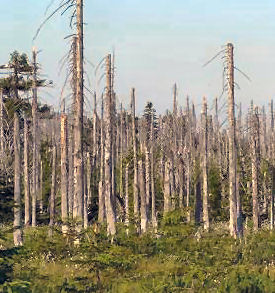
A new study in the Journal of Physical Chemistry suggests that the chemicals that helped solve a global environmental crisis in the 1990s - the hole in Earth's protective ozone layer - may be making another problem - acid rain - worse.

The chemicals in question, known as hydrochlorofluorocarbons (HCFCs), replaced the ozone-destroying chlorofluorocarbons (CFCs) once used in aerosol spray cans, air conditioners, refrigerators and other products.

It is already known that HCFCs act like super greenhouse gases, with a potency 4,500 times that of carbon dioxide. The new study adds to these existing concerns, raising the possibility that HCFCs may break down in the atmosphere to form oxalic acid, one of the main culprits in acid rain.

The researchers, from the University of Arkansas at Little Rock, used a computer model to show how HCFCs could form oxalic acid via a series of chemical reactions high in the atmosphere. This model, they drolly suggest, could help to determine whether replacements for the replacements are as eco-friendly as they appear before manufacturers spend billions of dollars in marketing them.

Related:
Ozone hole closure not so cool
Climatologists Mull Side-Effects Of Ozone Hole Closure

Source: American Chemical Society


Social

Follow Science a GoGo


Home         All The News      Science Forum         Books, Books, Books         Curiosity Shop         About

The terms and conditions governing your use of this website.
Copyright © 1997 - 2012 Science a Go Go and its licensors. All rights reserved.