Home   |   Sci News   |   Discussion Forum   |   Books, Books, Books   |   Curiosity Shop
Discussion Forum
Science Talk
Discuss scientific conundrums with our band of bamboozled boffins.
Search
Custom Search
Sponsored Links
Science Shopping
Sci Shop
Peculiar and bizarre scientific stuff that you didn't even know existed and you don't need.
News And Research

Animal Kingdom

Biology

Climate Change

Environment

Evolution

Genetics

Humans

Mind & Brain

Prehistory

Health & Diet

Health Threats

Health & Environment

Health: From The Lab

Mental Health

Reproductive Health

Energy Alternatives

Chemistry

Computing & Electronics

Nanotechnology

Pimping Nature

Robotics & AI

Physics

Space


Science Books
Book Reviews
Rusty Rockets lists his all-time favorite science titles.
Archives
2009 2008 2007
2006 2005 2004
2003 2002 2001
2000 1999 1998
Discussion Archive
Feature Archive


28 June 2005
Hubble Captures Tempel’s Premature Ejaculation
by Kate Melville

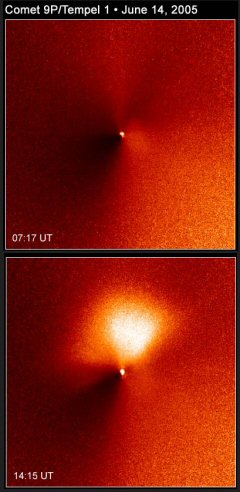
Astronomers got a preview of what Deep Impact's fourth of July rendezvous with the comet Tempel 1 may look like with images captured by the Hubble space telescope. The pictures have captured Tempel 1's icy nucleus - roughly the size of central Paris - ejecting material in a spectacular display. The ejaculation of dust and ice from the comet may be similar to what astronomers will see in less than a week, when a probe from the Deep Impact spacecraft will smash into the comet, blasting off material and giving rise to an artificially induced plume of material.

The fact that it's possible to discern the comet's details and ejaculatory activities through its vaporous exterior demonstrates the keenness of Hubble's vision. When the images of the comet were taken, the Earth-orbiting telescope was 120 million kilometers away. To put Hubble's capability into some kind of perspective, viewing the nucleus of the comet is as difficult as someone trying to spot a potato in Stockholm from Madrid. The task was made possible by the use of the Advanced Camera for Surveys' High Resolution Camera (ACS), which was installed in 2002.

The most spectacular image is that of the comet's 1367-mile long jet, seen as a bright fan-shaped area. While the jet is a well-known characteristic, astronomers are yet to explain why comets show such explosive flare-ups. Tempel 1's recent eruption could be explained by its sun bound trajectory, as the increasing heat may open up a crack in the comet's crusty surface. Another explanation could be that a portion of the crust itself was lifted off the nucleus by the pressure of heated gases beneath the surface. The porous crust might then crumble into small dust particles shortly after leaving the nucleus, producing a fan-shaped coma on the sunward side.

Looking ahead to next week, astronomers are hopeful that the Independence Day collision will discharge a multi-billion year old bounty of primordial material trapped inside the comet. Comets are thought to be 'dirty snowballs', porous agglomerates of ice and rock that dwell in the frigid outer boundaries of our solar system. In Europe, the European Southern Observatory will conduct a huge ground-based observing campaign before and in the week after the impact. Hubble's "eye" will also be focused on Tempel 1, complementing the close-up images being taken by cameras aboard Deep Impact, which has recently made a trajectory change in readiness for the rendezvous.

Source: Media release - ESA/Hubble Information Centre
Pic courtesy of Johns Hopkins University Applied Physics Laboratory


Home         All The News      Science Forum         Books, Books, Books         Curiosity Shop         About

The terms and conditions governing your use of this website.
Copyright © 1997 - 2009 Science a Go Go and its licensors. All rights reserved.