
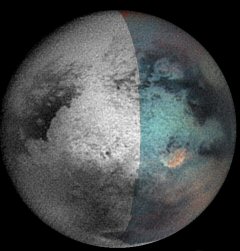
Scientists are mystified by images from the spacecraft Cassini that show an unusual bright spot (lower right of pic) on Saturn’s moon Titan. The 483-kilometer-wide spot is just southeast of the bright region called Xanadu and is visible to multiple instruments on the Cassini probe. Scientists believe the area may be a “hot” spot – an area warmed by a recent asteroid impact or by a mixture of water ice and ammonia from a warm interior, oozing out of an ice volcano onto colder surrounding terrain. Other possibilities for the unusual feature include landscape features holding clouds in place or exotic materials on the surface.
“I thought the feature looked strange, almost out of place,” said Cassini team member Robert H. Brown. “After thinking a bit, I speculated that it was a hot spot. In retrospect, that might not be the best hypothesis. But the spot is no less intriguing.”
“If the spot is a cloud, then its longevity and stability imply that it is controlled by the surface. Such a cloud might result from airflow across low mountains or outgassing caused by geologic activity,” said Jason Barnes, a researcher working with the visual and infrared mapping spectrometer team. “Titan’s surface seems to be mostly dirty ice. The bright spot might be a region with different surface composition, or maybe a thin surface deposit of non-icy material.”
The visual and infrared mapping spectrometer team will be able to test the hot spot hypothesis next year, when Cassini executes a nighttime flyby of the same area. If the spot glows at night, the researchers will know it’s hot.
Source: Media Release – Space Science Institute
Picture courtesy of the Cassini imaging team
Related posts:
 Cassini tracks equatorial methane rainstorms on Titan
 “It’s not you, it’s me,” means it’s probably you, say ovulation boffins
 Gender slant on hygiene hypothesis could explain skewed disease rates
 Hygiene Hypothesis linked to depression
 Brewing a primordial broth on Titan
 Saturn’s Rings Giving Up Some Of Their Secrets



Comments are closed.