Home   |   News   |   Discussion Forum   |   Books   |   Curiosity Shop
Discussion Forum
Science Talk
Discuss scientific conundrums with our motley band of bamboozled boffins.
Latest Posts
Why is our blood red
by janelee
Yesterday at 10:17 PM
Unified Field Theory?
by TheodoreToth
Yesterday at 08:41 PM
CFL - tempers in the house of (representatives ? )
by paul
Yesterday at 08:10 PM
a serious question to the forum
by paul
Yesterday at 07:22 PM
The Concept of the Whole and Threadism
by Revlgking
Yesterday at 11:45 AM
Search
Custom Search
Sponsored Links
Most Read
Hormones gone wild
Homo superior
New IPCC climate warning
In space, no one can hear you say "doh!"
Bow to your insect overlords!
Penis enlargement surprise: it's possible
Sex and the schizoid factor
Delusions and mental illness
We come in peace – not!
Eeew!
Small penis syndrome a big problem?
Have you hugged your robot today?
Down on the farm - yields, nutrients and soil quality
Cat parasite has global ambitions
Pop goes the planet
The disappearing male
Missing link a tripping chimp?
Inorganic dust formations alive?
Science Shopping
Sci Shop
Peculiar scientific stuff that you didn't even know existed and you don't need.
News And Research

Physics

Climate Change

Space

Natural World

Health

Technology


All 2009 News

Science Books
Book Reviews
Rusty Rockets reviews this week's science titles and lists his all-time faves.
Archives
2009 2008 2007
2006 2005 2004
2003 2002 2001
2000 1999 1998
Discussion Archive
Feature Archive


25 May 2005
Glaciers May Be Shrinking But Antarctic Ice Sheet Gains Mass
by Kate Melville

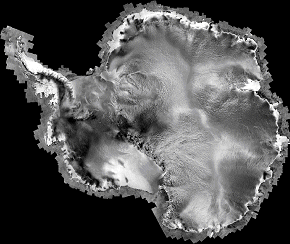
While some climate change research suggests that global sea levels are rising due to global warming and the shrinkage of glaciers, a new study in Science has found that the interior of the East Antarctic ice sheet is actually gaining mass.

Curt Davis, a researcher at the University of Missouri-Columbia, observed the ice sheet over a 10 year period using satellites and discovered that the ice sheet's interior was gaining mass by about 45 billion tons per year. The interior of the ice sheet is the only large terrestrial ice body that is likely gaining mass rather than losing it, said Davis. "Many recent studies have focused on coastal ice sheet losses and their contributions to sea level rise," Davis said. "This study suggests that the interior areas of the ice sheet also can play an important role. In particular, the East Antarctic ice sheet is the largest in the world and contains enough mass to raise sea level by more than 50 meters. Thus, only small changes in its interior can have a significant affect on sea level."

The study suggests that increased precipitation was the likely cause of the gain. The most recent U.N. Intergovernmental Panel on Climate Change confirmed this when it reported that Antarctica would likely gain mass due to increased precipitation in a warming climate. Interestingly, the study made no direct link to global warming. "We need more ice core measurements from East Antarctica to determine if this increased precipitation is a change from the past or part of natural variability," said Joe McConnell, co-author of the study. "Ice sheet response to climate change is a complex process that is difficult to measure and even more difficult to predict. The overall contribution of the Antarctic ice sheet to global sea-level change will depend on how mass changes in the ice sheet's interior balance mass changes from the coastal areas," concluded Davis.

Source: Media Release - University of Missouri-Columbia


Home            News            Discussion Forum            Books            Curiosity Shop            About

The terms and conditions governing your use of this website.
Copyright © 1997 - 2009 Science a Go Go and its licensors. All rights reserved.