
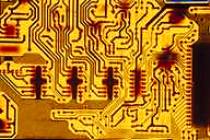
Engineers at the University of Rochester have created uniform silicon quantum dots-molecule-sized crystals of silicon that could someday offer computer manufacturers an economically viable way to slip beneath an impending limit to computer power. Every year computer makers squeeze more transistors onto each chip by designing smaller and smaller transistors; quantum dots take that trend to the extreme, reducing the central building block of a chip to a simple device just a few atoms across.
“In less than 10 years we’ll either have to find new ways to make transistors smaller, or the computer industry will halt its progress and stagnate,” says Philippe Fauchet, professor of electrical and computer engineering and co-creator of the dots. Since chip manufacturers are fast approaching the smallest size that they can make conventional transistors, they’re scrambling into the quantum world to create transistors of a very unconventional sort.
Scientists have been trying for years to make quantum-size transistors, which could be turned on or off by single electrons and would dramatically reduce a chip’s appetite for power. So far, most attempts have used expensive materials like indium gallium arsenide, but the new dots are made of silicon, which is cheap, plentiful, and already an integrated part of the semiconductor industry. The dots are of uniform size and shape, a necessity for computing and an achievement that has eluded previous attempts.
The switch is somewhat analogous to moving from gasoline to electric cars: The infrastructure for gasoline is already entrenched, so it’s easier to introduce a gasoline-electric hybrid that uses the current infrastructure than an all-electric vehicle that demands a whole new transport system, new refueling stations, and so on.
In an effort to create that smooth transition, a team of experts from the United States, Germany, France and Canada formed the Nanoscale Silicon Research Initiative (NSRI) and dedicated themselves to creating the dots from silicon, the mainstay of the electronics industry. NSRI is funded by the National Science Foundation, Army Research Office, Motorola and Semiconductor Research Corporation. Tsybeskov is the director of NSRI and lead author of the paper that appears in the Sept. 21 issue of the journal Nature detailing the team’s success.
“This had to be a worldwide effort,” says Tsybeskov of the research team that created the dots. “Material science is expensive, so this achievement demanded cooperation among people of different countries.” Much of that cooperation came in the form of shared equipment, such as expensive transmission electron microscopes to see what form the tiny crystals took, or programmable ovens that could warm up from room temperature to thousands of degrees in less than a minute.
Quantum dots made from materials other than silicon are used in some limited ways today, including highly efficient light emitters that help biologists track single cells, but engineers believe they could also power new computers to speeds unimaginable today. The strange world of quantum mechanics allows a dot transistor to be both on and off at the same time, and computer scientists are looking to exploit the dots in ways that make today’s gigahertz chips the equivalent of a slide rule.
Efforts at making quantum dots from silicon have resulted in inconsistent dots of varying size and shape, making them useless for computing needs. Most scientists gave up the effort. Eventually, after many attempts, the University of Rochester researchers discovered a heating process that produced regular, even crystals. The team found that by heating the silicon to more than 2,000 degrees Fahrenheit and cooling it repeatedly inside a nitrogen atmosphere, silicon begins to organize itself into orderly rows of crystals, like bricks just a few atoms wide.
Eventually, these dots could be linked together to make a complete circuit. Millions of dots would be laid out on a chip much like today’s transistors, though one of the great upcoming hurdles will be to devise a way to keep the dots insulated from one another, yet able to communicate. Whole computer chips checkered with dots could be faster than today’s supercomputers while only being the size of a pinhead, if engineers are successful in putting the quirks of the quantum world to work to form the basis of computers.
Tsybeskov and Fauchet will next look into how to place the silicon dots into a usable pattern on a chip so that the dots may perform calculations.
“There’s a very good chance that, if everything goes well, the industry will be making quantum-based computers within the next 10 years,” says Fauchet, referring to the impending size limit. “And if not in 10 years, they’d better do it pretty shortly thereafter.”
Related posts:
 Mars astronauts will suffer significant brain damage
 Scientists create artificial link between unrelated memories
 The longer a mother breastfeeds, the higher the IQ and salary
 Atoms Coaxed Into Quantum “Cat” State
 Chinese Research Lost In Translation
 Human Guinea Pig Success For Omega 3 Cancer Treatment


Comments are closed.