
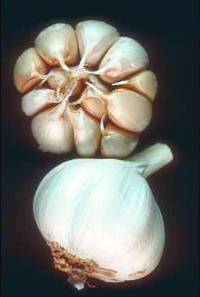
Garlic might not make breath smell like springtime in the Alps, but it can help protect against stomach and colorectal cancer, according to a new study.
The University of North Carolina at Chapel Hill study shows that people who consume raw or cooked garlic regularly face about half the risk of stomach cancer and two-thirds the risk of colorectal cancer as people who eat little or none.
“There seems to be a strong, consistent protective effect for people who are regular garlic consumers,” said Dr. Lenore Arab, professor of epidemiology and nutrition at the UNC-CH schools of public health and medicine. “It doesn’t matter if they’re consuming garlic in China or in the United States, the effect is still there.”
UNC-CH researchers could not show similar benefits from taking garlic supplements, however, said Arab, a member of the UNC Lineberger Comprehensive Cancer Center. They do not know why.
A report on the findings appears in the October issue of the American Journal of Clinical Nutrition, a professional journal. Besides Arab, authors are graduate student Aaron T. Fleischauer and Dr. Charles Poole, associate professor of epidemiology.
“We’ve looked at garlic in the past and thought the findings looked overwhelmingly consistent,” Arab said. “Here we took a formal approach to pooling the data from various studies done in Argentina, China, Switzerland, the Netherlands and other countries. We had a very good diversity of countries represented.”
Previous research has shown that a compound in garlic called allium partially protects animals against cancer, and some scientists believe it has the same effect in humans, she said.
“After controlling for various risk factors, we found that when we pooled the results, this preventive effect was largely confirmed,” Arab said. “We didn’t have enough information to be able to say the same about garlic’s possible effects on other forms of cancer.”
Possible benefits of consuming garlic might be somewhat overestimated in the study by what is called “publication bias,” Poole said. That is the well-documented tendency of scientists and scientific publications to publish positive findings more often than results showing no effect.
“We also found the various studies were more inconsistent than we would have expected,” he said.
“This is speculation, but it might be that we saw no benefits from garlic supplements because the active ingredients are being destroyed in processing or by sitting on store shelves for a long time,” Arab said. “Another possibility is that some of the people who turn to garlic supplements are sick already. That could skew the results.”
The small number of studies that included garlic supplements also make conclusions about their effects more difficult to draw, Fleischauer said.
“Many scientists believe garlic helps prevent stomach cancer because it has anti-bacterial effects against a bacterium, Helicobacter pylori, found in the stomach and known to promote cancer there,” he said.
Related posts:
 Mars astronauts will suffer significant brain damage
 Scientists create artificial link between unrelated memories
 The longer a mother breastfeeds, the higher the IQ and salary
 Atoms Coaxed Into Quantum “Cat” State
 Chinese Research Lost In Translation
 Human Guinea Pig Success For Omega 3 Cancer Treatment





Comments are closed.