

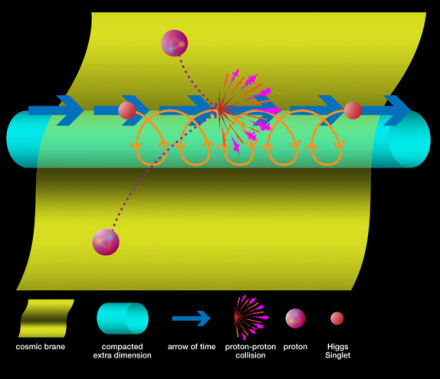
If the Large Hadron Collider (LHC) does produce the elusive Higgs boson, then Vanderbilt University physicists speculate that it will also create a second particle, known as the Higgs singlet, that can move either forward or backward in time and reappear in the future or past. “Our theory is a long shot,” admitted Vanderbilt Physics professor Tom Weiler, “but it doesn’t violate any laws of physics or experimental constraints.”
The theory should be easy to test. If Higgs singlet particles and their decay products start spontaneously appearing at the LHC then Weiler and Ho believe that they will have been produced by particles that travel back in time to appear before the collisions that produced them.
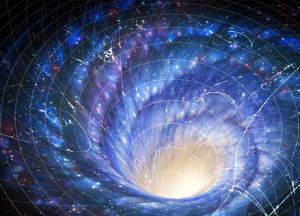
The time travel idea is based on M-theory, a favored contender for a “theory of everything.” Theoretical physicists have developed M-theory to the point that it can accommodate the properties of all the known subatomic particles and forces, including gravity, but it requires 10 or 11 dimensions instead of our familiar four. This has led to the suggestion that our universe may be like a four-dimensional membrane or “brane” floating in a multi-dimensional space-time called the “bulk.”
In M-theory, the basic building blocks of our universe are permanently “stuck” to the brane and so cannot travel in other dimensions. There are some exceptions, however, such as the proposed Higgs singlet, which responds to gravity but not to any of the other basic forces.
Weiler and colleagues came up with an explanation of the anomalies based on the existence of a hypothetical particle called the sterile neutrino. In theory, sterile neutrinos are even less detectable than regular neutrinos because they interact only with gravitational force. As a result, sterile neutrinos are another particle that is not attached to the brane and so should be capable of traveling through extra dimensions.
These sterile neutrinos travel faster than light by taking shortcuts through extra dimensions, explains Weil. According to Einstein’s general theory of relativity, there are certain conditions where traveling faster than the speed of light is equivalent to traveling backward in time.
Related:
The Universe As Magic Roundabout
String Theory Faster-Than-Light Drive Proposed
LHC revs up to set new world record
Modified Newtonian dynamic could do away with dark matter
Central tenet of theory of relativity looks shaky
Source: Vanderbilt University
Related posts:
 Table-top particle accelerator sets world record
 The cloning of quantum information from the past may be Achilles’ heel of quantum cryptography
 Spring-assisted exoskeleton beats evolution
 Mysterious “action at a distance” between liquids may be commonplace
 Spinning nanoparticles hint at origin of life
 Collapse of Universe may be sooner rather than later








Comments are closed.