
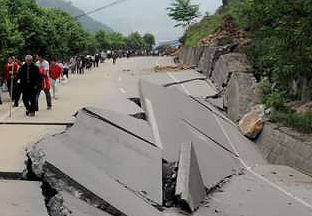
US seismologists say the 2004 earthquake that triggered tsunamis throughout the Indian Ocean weakened California’s San Andreas Fault, suggesting that large earthquakes can weaken fault zones worldwide and may trigger periods of increased global seismic activity.
“An unusually high number of magnitude 8 earthquakes occurred worldwide in 2005 and 2006,” said study co-author Fenglin Niu, of Rice University. “There has been speculation that these were somehow triggered by the Sumatran-Andaman earthquake that occurred on Dec. 26, 2004, but this is the first direct evidence that the quake could change fault strength of a fault remotely.”
The magnitude 9 earthquake in 2004 occurred beneath the ocean west of Sumatra and was the second-largest quake ever measured by seismograph. The temblor spawned tsunamis as large as 100 feet that killed an estimated 230,000, mostly in Indonesia, Sri Lanka, India and Thailand.
In the new study, Niu and co-authors Taka’aki Taira and Paul Silver, both of the Carnegie Institution of Science in Washington, D.C., and Robert Nadeau of the University of California, Berkeley, examined more than 20 years of seismic records from Parkfield, Calif., which sits astride the San Andreas Fault. The team zeroed in on a set of repeating microearthquakes that occurred near Parkfield over two decades. Each of these tiny quakes originated in almost exactly the same location.
By closely comparing seismic readings from these quakes, the team was able to determine the “fault strength” – the shear stress level required to cause the fault to slip – at Parkfield between 1987 and 2008. The team found fault strength changed markedly at three times during the 20-year period.
The second change in fault strength occurred in conjunction with a magnitude 6 earthquake at Parkfield in September 2004. The team found another change at Parkfield later that year that could not be accounted for by the September quake alone. Eventually, they were able to narrow the onset of this third shift to a five-day window in late December during which the Sumatran quake occurred.
“The long-range influence of the 2004 Sumatran-Andaman earthquake on this patch of the San Andreas suggests that the quake may have affected other faults, bringing a significant fraction of them closer to failure,” noted Taira. “This hypothesis appears to be borne out by the unusually high number of large earthquakes that occurred in the three years after the Sumatran-Andaman quake.”
Related:
Under Pressure: Earth Science
Scientists Mull Earthquake Love Waves
Quake detection gets cheap and cheerful
Bacteria Used To Reinforce Buildings
Source: Rice University
Related posts:
 Toxin producing algae key to mass extinctions, claims new study
 PSA test blamed for massive overdiagnosis of prostate cancer
 The repulsive side of light
 Earth to get hotter sooner
 Compelling new evidence for benefits of circumcision
 New evidence linking marijuana use to brain abnormalities in adolescents

Comments are closed.