Home   |   News    |   Discussions   |   Books   |   Curiosities
Search
Custom Search
Popular Reads

Earthquakes and animal behavior
LHC may produce time travelling particles
Country boys boast bigger junk
Running the numbers on alien life
Uh-oh, placebo
Forgetful? Blame your house
Pill to blame for rise in prostate cancer?
Cat parasite has global ambitions
Carbon monoxide keeps city dwellers happy
Magnetic field alters moral judgments
Stars manufacturing organic matter?
Unnatural selection: Courtesy of The Pill
Men 2% funnier than women
Parasite rewires sexual attraction
Novel psychiatric drugs take aim at gut bacteria
Discussions
General Science

Not-Quite Science

Physics

Climate Change

Science Fiction

Past Forums

Sponsored Links
Browse

Animal Kingdom

Biology

Climate Change

Environment

Evolution

Genetics

Humans

Mind & Brain

Prehistory

Health & Diet

Health Threats

Health & Environment

Health: From The Lab

Mental Health

Reproductive Health

Energy Alternatives

Chemistry

Computing & Electronics

Nanotechnology

Pimping Nature

Robotics & AI

Physics

Space


Curiosities
Sci Shop
Peculiar and bizarre scientific stuff that you didn't even know existed and you don't need.
Books
Book Reviews
Rusty Rockets lists his all-time favorite science titles.
Archives
2012 2011 2010
2009 2008 2007
2006 2005 2004
2003 2002 2001
2000 1999 1998
Feature Archive


27 January 2009
Biologists mull rapid, non-adaptive gene mutations
by Kate Melville

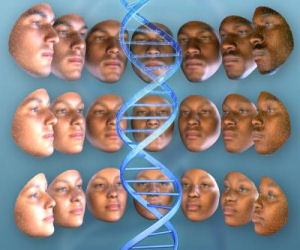
Scientists attempting to discover why some human genes evolved very rapidly believe that biased gene conversion (a non-adaptive evolutionary process) may be a significant factor, above and beyond Darwinian natural selection.

Describing their results in the journal PLoS Biology, the Uppsala University researchers describe how they identified fast evolving human genes by comparing our genome with those of other primates.

Surprisingly, the patterns of molecular evolution in many of the genes they found did not contain "signals" of natural selection. Rather, their evidence suggests that biased gene conversion (BGC) has massively speeded up the rate of evolution in certain genes. This process increases the rate at which certain mutations spread through a population - regardless of whether they are beneficial or harmful.

"The research not only increases our understanding of human evolution, but also suggests that many techniques used by evolutionary biologists to detect selection may be flawed," noted Uppsala's Matthew Webster.

BGC is thought to be strongest in regions of high recombination, and can cause harmful mutations that can then spread through populations. Interestingly, the results lead to the provocative hypothesis that, rather than being the result of Darwinian selection for new adaptations, many of the genetic changes leading to human-specific characteristics may be the result of the fixation of harmful mutations. This contrasts the traditional Darwinistic view that they are the result of natural selection in favor of adaptive mutations.

Related:
Adaptive proteins "control" their own evolution
Modern Man In Evolutionary Fast Lane
Shifting Evolution Up A Gear

Source: Uppsala University


Social

Follow Science a GoGo


Home         All The News      Science Forum         Books, Books, Books         Curiosity Shop         About

The terms and conditions governing your use of this website.
Copyright © 1997 - 2012 Science a Go Go and its licensors. All rights reserved.