
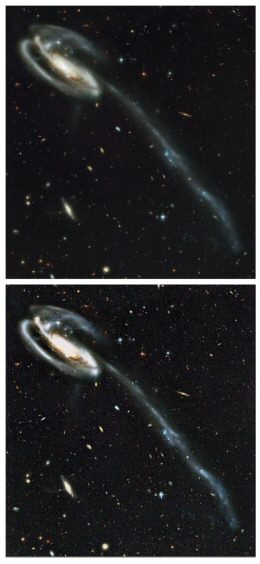
A fast and efficient image enhancement technique that was originally applied to improving monochrome microscope images has proved itself equally effective at the other end of the scale – sharpening details on color images of distant galaxies produced by the Hubble Space Telescope. Its effectiveness at cleaning up images from outer space (before and after pics appear right) was a welcome surprise to mathematician Alfred Carasso, from the National Institute of Standards and Technology (NIST), where the technique was developed.
Carasso explained that blurring can be thought of as a set of mathematical operations that are applied to every point in an image which result in that point being spread out and diffused. But if the blurring function can be identified down to the exact set of operations involved, the blur can be removed by delicate numerical manipulation. While it sounds simple, in practice it is much more difficult, as many things can contribute to blur – motion of the object, motion of the imager, irregularities in the optics and atmospheric effects.
Back in 2001, Carasso developed a technique – the APEX method – as a general solution to a specific limited class of blur: blur that is symmetric and has certain other mathematical characteristics. APEX is based on a major simplifying assumption that makes it fast and “blind” – that is, it doesn’t need to “know” the underlying point spread function in advance, but rather deduces it from the image.
The simplifying assumption doesn’t make it suitable for all types of images and APEX was originally limited to deblurring monochrome images from scanning electron microscopes. But Carasso decided to try applying APEX to color images from the Hubble Advanced Camera for Surveys, even though deblurring color images is even more involved, as the (still unknown) point spread function can be different for different color components.
But the results were stunning, as APEX successfully detected and corrected unusual optical blurring functions in several astronomical images and delivered strikingly enhanced versions of well-known Hubble images, including the Whirlpool and Tadpole galaxies. “There is an element of luck in scientific research,” Carasso says, “sometimes a simple formulation, based on the right intuition, works out a lot better than you ever expected.”







Comments are closed.