
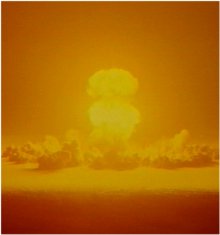
Two new studies predict that even a small-scale regional nuclear war could produce as many fatalities as all of World War II, disrupt the global climate for a decade or more and impact nearly every person on Earth. Appearing in the journal Atmospheric Chemistry and Physics Discussions, the studies were compiled by researchers from the University of Colorado at Boulder, Rutgers University and University of California, Los Angeles.
The studies represent the first quantitative assessment of the consequences of a nuclear conflict between small or emerging nuclear powers, said study leader CU-Boulder Professor Owen “Brian” Toon. “Considering the relatively small number and yields of the weapons, the potential devastation would be catastrophic and long term,” he added, citing fatality estimates for such a regional conflict of between 2.6 million to 16.7 million people per country. The estimates were based on current nuclear weapons inventories and population densities in large urban regions and took into account scenarios of smoke emissions that urban firestorms could produce.
The researchers estimate that smoke emissions from firestorms in such a conflict could exceed 5 million metric tons, which would have a huge potential impact on climate. Additionally, given that a small-scale nuclear exchange would likely be focused on large population centers, the quantity of black smoke per kiloton of explosives would be far higher that that generated during a full-scale superpower nuclear exchange.
To assess the effects on global climate, the researchers used a model based on 50 Hiroshima-sized nuclear weapons used to attack the most populated urban areas of each country. “Considering the relatively small number and size of the weapons, the effects are surprisingly large,” said UCLA Professor Richard Turco, a co-author on both papers. The bottom line, according to the researchers, is that while a regional nuclear confrontation among emerging third-world nuclear powers might be geographically constrained, the environmental impacts likely would be worldwide.
The model predicts a cooling of several degrees over large areas of North America and Eurasia, including most of the grain-growing regions. Killing frosts and crop losses in New England as well as crop failures, food shortages and famines in Europe from wet and cold weather would be the result, say the researchers. The resulting smoke would cause large amounts of carbon particles to remain in the stratosphere for up to 10 years, triggering unprecedented climate change, they added.
Nuclear proliferation, political instability and urban demographics; “forms perhaps the greatest danger to the stability of human society since the dawn of man,” warned Toon. “The current buildup of nuclear weapons in a growing number of states points to scenarios in the next few decades that are even more extreme than those considered in this analysis.”
Check out the two studies:
Climatic consequences of regional nuclear conflicts
Atmospheric effects and societal consequences of regional scale nuclear conflicts and acts of individual nuclear terrorism















Comments are closed.