
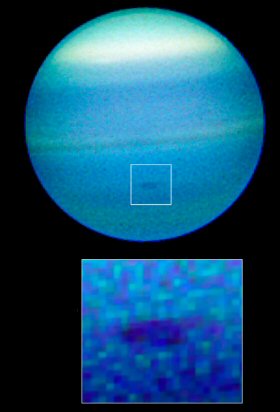
Two billion miles away in the atmosphere of Uranus, a dark vortex large enough to engulf two-thirds of the United States has appeared. Measuring 1,100 by 1,900 miles, the Hubble telescope captured images of the phenomenon which astronomers believe is a huge storm.
Previous Hubble images of Uranus taken over the last decade have shown no dark spot, leading astronomers to believe that the disturbance formed only very recently. Prior to Hubble, there were unconfirmed sightings of other dark spots on Uranus, including sketches made in the early 1900s, low-contrast Voyager spacecraft fly-by images in 1986, and near-infrared observations taken from a ground-based observatory in 1993.
While rare on Uranus, dark spots have been frequently observed on Neptune. It was believed that while Uranus is similar in size and atmospheric composition to Neptune, it did not have such an active atmosphere. Lawrence Sromovsky, who led the team that took the pictures, said that recently, however, Uranus’s atmosphere had shown an unusual increase in activity.
The disturbance was detected at a latitude of 27 degrees in Uranus’s northern hemisphere, which is just now becoming fully exposed to sunlight after decades of being in shadow (Uranus takes 84 years to orbit the sun). How Uranus responds to seasonal sunlight changes is of great interest to astronomers as Uranus’s sideways orientation (its rotation axis is tilted almost parallel to its orbital plane, such that the planet appears to be rotating on its side) could produce more unusual atmospheric phenomena.
Source: Space Telescope Science Institute
Pic courtesy NASA, ESA, L. Sromovsky and P. Fry (University of Wisconsin), H. Hammel (Space Science Institute), and K. Rages (SETI Institute)
Related posts:
 Locate alien civilizations by their pollution, suggest astrophysicists
 Newly discovered neighboring star as cold as the North Pole
 Wobbly planets could be best place for finding life, say astrobiologists
 Bolivian park most biodiverse area on planet
 Atmospheric analysis yields dog poop surprise
 Mars-like Soils Can Harbor Life









Comments are closed.