
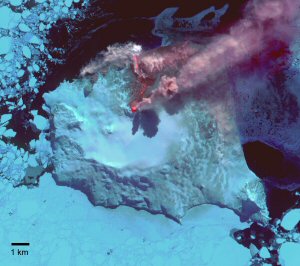
Montagu Island, part of the South Sandwich Islands about 2000 kilometers from mainland Antarctica, is home to a newly erupting volcano with a fast-moving lava flow that has caused the island to grow by about 50 acres in the last month. Spectacular new satellite images (click image for enlarged view) surprised researchers who believed the volcano was settling down after an initial burst of activity in 2001.
Researchers from the British Antarctic Survey (BAS) only became aware of the new eruption after seeing the satellite images. The images show a large and fast flowing lava flow that is pouring into the sea like a huge waterfall. “Red hot lava has formed a molten river 90 metres wide that is moving fast, possibly several metres per second, and extending the shoreline on the north side of the island. This event is special because Montagu Island is mostly ice covered and it’s very rare that we get to make direct observations of eruptions under ice sheets,” said BAS researcher Dr John Smellie, a leading authority on volcanoes.
Dr Smellie intends to get there for a first hand look as soon as possible. He plans to fly over the volcano in the New Year to get more close-up views for his research. “My work usually involves studying Antarctic rock formations to find out how past eruptions affected the growth and retreat of ice sheets over the last 30 million years. This opportunity to monitor a live eruption and see how it affects ice cover is priceless,” he said.
Visit the British Antarctic Survey Website
Source: British Antarctic Survey
Pic courtesy HIGP (M. Patrick)/BAS
Related posts:
 Marine organisms evolving in response to ocean acidification
 Could heat from a Martian volcano create a habitable environment?
 Unusual gem find provides evidence for vast underground oceans
 Volcanoes keeping a lid on global warming
 Double whammy dinosaur extinction theory
 New Slant On Volcanic Climate Change







Comments are closed.