

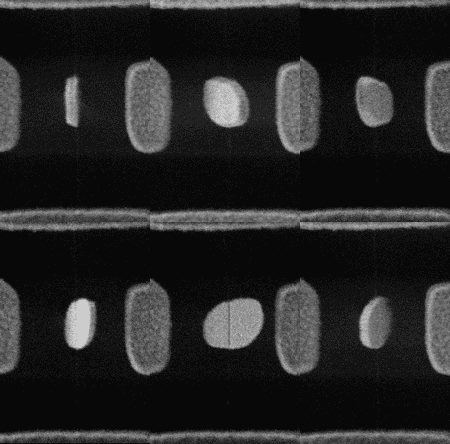
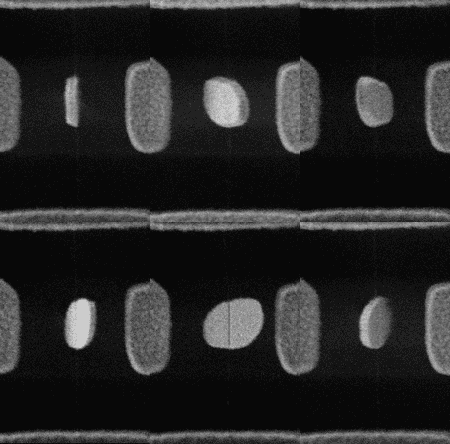
Only 15 years after University of California, Berkeley, engineers built the first micro-scale motor, a UC Berkeley physicist has created the first nano-scale motor – a gold rotor on a nanotube shaft that could ride on the back of a virus.
“It’s the smallest synthetic motor that’s ever been made,” said Alex Zettl, professor of physics at UC Berkeley and faculty scientist at Lawrence Berkeley National Laboratory. “Nature is still a little bit ahead of us – there are biological motors that are equal or slightly smaller in size – but we are catching up.” Zettl and his research group report their feat in the current issue of Nature.
The electrostatic motors represent a significant step foward in nanotechnology, and prove that nanotubes and other nanostructures several hundred times smaller than the diameter of a human hair can be manipulated and assembled into true devices.
Zettl and other scientists had previously made transistors from nanotubes, but this device is different, he said.
“It’s the first device where you can put external wires on it and have something rotating, something you can control,” he said. “We are pushing a lot of different technologies to the edge.”
Such motors could have numerous uses, Zettl said. Because the rotor can be positioned at any angle, the motor could be used in optical circuits to redirect light, a process called optical switching. The rotor could be rapidly flipped back and forth to create a microwave oscillator, or the spinning rotor could be used to mix liquids in microfluidic devices.
The motor is about 500 nanometers across, 300 times smaller than the diameter of a human hair. While the part that rotates, the rotor, is between 100 and 300 nanometers long, the carbon nanotube shaft to which it is attached is only a few atoms across, perhaps 5-10 nanometers thick.
The motor has highlighted some unexpected difficulties. Measuring the motor’s speed, for example, can only be accomplished crudely. The team’s scanning electron microscope (SEM) can take pictures every 33 milliseconds and no faster, so they can’t tell whether the rotor spins or flips faster than 30 times per second.
“We assume you could go much, much faster than that, probably to microwave frequencies,” Zettl said. “There’s no way we can detect that right now, but in principle the motor should be able to run that fast.”
Microwave frequencies, common in communication networks, are above a billion cycles per second, in the gigahertz frequency range.
To build the motor, Zettl and his team made a slew of multiwalled nanotubes in an electric arc and deposited them on the flat silicon oxide surface of a silicon wafer. They then identified the best from the pile with an atomic force microscope, a device capable of picking up single atoms.
A gold rotor, nanotube anchors and opposing stators were then simultaneously patterned around the chosen nanotubes using electron beam lithography. A third stator was already buried under the silicon oxide surface. The rotor was annealed to the nanotubes and then the surface selectively etched to provide sufficient clearance for the rotor.
When the stators were charged with up to 50 volts of direct current, the gold rotor deflected up to 20 degrees, which was visible in the SEM. With alternating voltage, the rotor rocked back and forth, acting as a torsional oscillator. Such an oscillator, probably capable of microwave frequency oscillations from hundreds of megahertz to gigahertz, could be useful in many types of devices – in particular, communications devices such as cell phones or computers.
With a strong electrical jolt to the stators, the team was able to jerk the rotor and break the outer wall of the nested nanotubes, allowing the rotor to spin freely on the nested nanotube bearings. Zettl had made similar bearings several years ago, but this was the first time he had put them to use.
“The real breakthrough came a couple of years ago, when we discovered a method for peeling shells off multiwalled nanotubes and grabbing the core with a homemade nano-manipulator operating inside a transmission electron microscope (TEM),” Zettl said. “We showed that you could pull out the cores and they really did slide, they really did behave as a bearing. That technological leap allowed us to go full bore on the motor and really have confidence we could make it in the laboratory.”
Interestingly, the rotor does not continue spinning for long once the electricity is turned off. It is so small that it has little inertia, so any tiny electric charges remaining on the device after it’s turned off tend to stop the rotor immediately.
“The nanoworld is weird – different things dominate,” Zettl said. “Gravity plays no role whatsoever and inertial effects are basically nonexistent because things are just so small, so that little things like residual electric fields can play a dominant role. It’s counter intuitive.”
Zettl expects to be able to reduce the size even further, perhaps by a factor of five. For the moment, though, he and his team are trying to make basic quantum measurements, such as the conductance through the nanotubes and the amount of friction in the bearings.
“There are many very fundamental questions we are trying to answer,” he said. “The flip side is, we’ve got this incredibly neat little motor that’s smaller than any other electric motor – let’s try to integrate it into some larger architecture where people are making microelectromechanical devices or nanoelectromechnical devices. People will build on this.”
Photo courtesy Zettl lab