Home   |   News    |   Discussions   |   Books   |   Curiosities
Search
Custom Search
Popular Reads

Earthquakes and animal behavior
LHC may produce time travelling particles
Country boys boast bigger junk
Running the numbers on alien life
Uh-oh, placebo
Forgetful? Blame your house
Pill to blame for rise in prostate cancer?
Cat parasite has global ambitions
Carbon monoxide keeps city dwellers happy
Magnetic field alters moral judgments
Stars manufacturing organic matter?
Unnatural selection: Courtesy of The Pill
Men 2% funnier than women
Parasite rewires sexual attraction
Novel psychiatric drugs take aim at gut bacteria
Discussions
General Science

Not-Quite Science

Physics

Climate Change

Science Fiction

Past Forums

Sponsored Links
Browse

Animal Kingdom

Biology

Climate Change

Environment

Evolution

Genetics

Humans

Mind & Brain

Prehistory

Health & Diet

Health Threats

Health & Environment

Health: From The Lab

Mental Health

Reproductive Health

Energy Alternatives

Chemistry

Computing & Electronics

Nanotechnology

Pimping Nature

Robotics & AI

Physics

Space


Curiosities
Sci Shop
Peculiar and bizarre scientific stuff that you didn't even know existed and you don't need.
Books
Book Reviews
Rusty Rockets lists his all-time favorite science titles.
Archives
2012 2011 2010
2009 2008 2007
2006 2005 2004
2003 2002 2001
2000 1999 1998
Feature Archive


22 August 2008
Growing A Home With "Plantware"
by Kate Melville

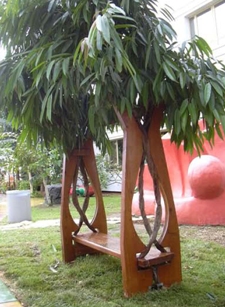
A bus-stop that grows its own foliage as shade? A house built from living tree roots that provides natural protection against earthquakes? These concepts may be science fiction today, but scientists from Tel Aviv University say that eco-architecture using "plantware" may be only a decade away.

The concept of shaping living trees into useful objects - known as arborsculpture or pooktre - isn't new. But Tel Aviv University Professors Yoav Waisel and Amram Eshel are ready to use this concept as the foundation for a new company that will roll out these structures worldwide. Pilot projects now underway in the United States, Australia and Israel include park benches for hospitals, playground structures, streetlamps and gates.

"The approach is a new application of the well-known botanical phenomenon of aerial root development," says Prof. Eshel. Certain species of trees grown aeroponically (in air instead of soil and water) do not harden, he explained, adding that "soft roots" can relatively easily turn living trees into useful structures. "Instead of using plant branches, this patented approach takes malleable roots and shapes them into useful objects for indoors and out."

The original "root-breaking" research was conducted at the Sarah Racine Root Research Laboratory at Tel Aviv University (TAU), the first and largest aeroponics lab in the world. Commercial applications of the research are being developed by Plantware, a company founded in 2002. Plantware CEO Gordon Glazer hopes the first home prototype will be ready in about a decade. While this method of "growing your own home" can take years, the result is long lasting and, according to Glazer, particularly desirable in this emerging age of green architecture.

Related:
Evolutionary Algorithms Used To Design A Better Leaf
Pimping Nature

Source: Tel Aviv University


Social

Follow Science a GoGo


Home         All The News      Science Forum         Books, Books, Books         Curiosity Shop         About

The terms and conditions governing your use of this website.
Copyright © 1997 - 2012 Science a Go Go and its licensors. All rights reserved.