

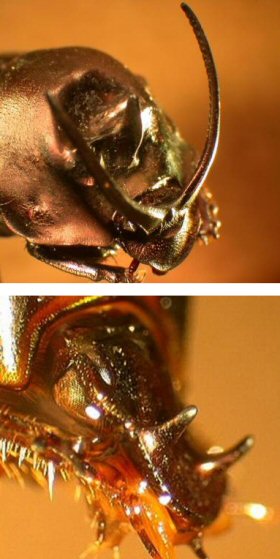
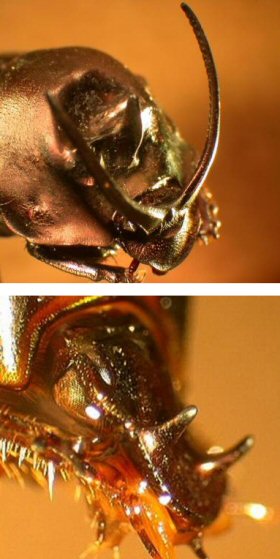
Indiana University researchers examining male horned beetles (Onthophagus Taurus) from four geographically separated populations say the groups have diverged significantly in the size of the male genitalia, and natural selection operating on the other end of the animal – the fighting horns atop the beetles’ heads (pictured) – seems to be driving it much more quickly than expected.
Biologists know that in these beetles there is an investment trade-off between secondary sexual characters and primary sexual characters,” researcher Armin Moczek explained. “As horns get bigger, copulatory organs get smaller, or vice versa. What was not known was how frequently and how fast this can occur in nature, and whether this can drive the evolution of new species.” Structures directly involved in mating are known as primary sexual characters, whereas combat structures like horns – or attributes like a peacock’s plumage or a bullfrog’s deeply resonant baritone – are known as secondary sexual characters.
Evolutionary biologists believe changes in genitalia size and shape can spur speciation by making individuals from different populations sexually incompatible. An early “lock and key” model of reproductive isolation was first proposed in the nineteenth century to explain why some pairs of species, outwardly identical in every way, are unable to mate.
The scientists examined 10 other Onthophagus species, and as expected, they found vast differences between the species regarding horn and male genitalia size. Moczek says this suggests that trade-offs between primary and secondary sexual traits continue to shape the way species diverge well after speciation has occurred. But the speed and magnitude of divergence within O. Taurus presents something of a paradox. How is it that genitalia size can be so rigorously maintained within the populations of a single species, yet appear so restless to change?
“In terms of the integrity of a species, it’s important for these things not to change too much,” Moczek explains. “So there is a lot of evidence suggesting that within species or within the populations of species, natural selection maintains genital characters. But if these primary sex characters are linked to other characters that can change readily, then you’ve got what we think is a very exciting mechanism that could prime populations for reproductive isolation.”
Horn length and shape can change for many reasons, Moczek says. Among densely populated species, fighting (which favors large horns) may not be an effective strategy for winning mates. As combative males fight each other, a diminutive, smaller-horned male could simply employ a sneaking strategy to gain access to unguarded females. Under these circumstances, reduced investment in horns seems to result in larger copulatory organs. Alternately, in lower density populations, most male beetles spend a great deal of time fighting. Longer, bigger horns could serve these males well – and also lead to smaller genitalia. “If this is all it takes to change genitalia, it may be easier to make new species than we thought,” Moczek mused.
Related:
For Some Females, Size Does Matter
Balls vs Brains In Batty Battle For Evolutionary Success
Small Penis Syndrome A Big Problem?
Researchers Investigate Giant Sperm Paradox
Source: Indiana University