Home   |   News   |   Discussion Forum   |   Books   |   Curiosity Shop
Discussion Forum
Recent Posts
The platypus genome sequenced
redewenur
Today at 12:55 AM
Philosophy of Religions--all religions, including,
Anonymous
Today at 12:38 AM
edge of space; plausible
Mike Kremer
Yesterday at 10:05 AM
Zealotry over Global Warming
ImranCan
Yesterday at 07:07 AM
How Reliable are those climate models?????
Canuck
05/10/08 06:38 PM
Biofuels Starve the Poor
redewenur
05/10/08 08:00 AM
Artic Ice Free by 2013 !!
samwik
05/10/08 01:07 AM
Semantics, Etymology, Syntactics, Etc.
samwik
05/10/08 12:10 AM
Humanzee? Ape Human Cross
Ellis
05/09/08 11:43 PM
The Mystery of Global Warming's Missing Heat
Mike Kremer
05/09/08 04:12 PM
Hot Topics

The Environment

Evolution

Space

Mind/Brain

Electronics

Climate Change


Sponsored Links
Most Read
Hormones Gone Wild
Homo Superior
The Universe As Magic Roundabout
In Space, No One Can Hear You Say "Doh!"
Bow To Your Insect Overlords!
Bionics
Sex And The Schizoid Factor
Delusions And Mental Illness
We Come In Peace – NOT!
Eeew!
Small Penis Syndrome A Big Problem?
Have You Hugged Your Robot Today?
Down On The Farm - Yields, Nutrients And Soil Quality
Cat Parasite Has Global Ambitions
POP Goes The Planet
The Disappearing Male
Missing Link A Tripping Chimp?
Inorganic Dust Formations Alive?
Science Shopping
Sci Shop
Peculiar scientific stuff that you didn't even know existed and you don't need.
News And Research

Physics

Climate Change

Space

Natural World

Health

Technology


All 2008 News

Rusty's Reading List
Sci Books
Join Rusty Rockets for the lowdown on what you should be reading.
Search
Google

Science a GoGo Web
Archives
2008 2007
2006 2005 2004
2003 2002 2001
2000 1999 1998
Discussions
Features


18 January 2008
Flexible Electronics Melded With Contact Lens Creates Bionic Eye
by Kate Melville

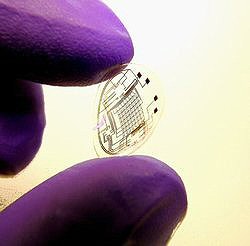
Engineers at the University of Washington (UW) have for the first time used microscopic manufacturing techniques to combine a flexible, biologically safe contact lens with an imprinted electronic circuit and lights. "Looking through a completed lens, you would see what the display is generating superimposed on the world outside. People may find all sorts of applications for it that we have not thought about. Our goal is to demonstrate the basic technology and make sure it works and that it's safe," said Babak Parviz, who heads a multi-disciplinary UW group that is developing electronics for contact lenses.

The results were presented this week at the Institute of Electrical and Electronics Engineers' international conference on Micro Electro Mechanical Systems by Harvey Ho, a former graduate student of Parviz's now working at Sandia National Laboratories in Livermore, California.

The prototype device contains an electric circuit as well as red light-emitting diodes for a display, though it does not yet light up. The lenses were tested on rabbits for up to 20 minutes and the animals showed no adverse effects. Parviz says that installing or removing the bionic eye would be as easy as popping a contact lens in or out, and once installed the wearer would barely know the gadget was there.

Building biologically safe lenses was a challenge because electrical circuits require inorganic materials and toxic chemicals. Parviz's team built the circuits from layers of metal only a few nanometers thick and constructed light-emitting diodes one third of a millimeter across. They then sprinkled the grayish powder of electrical components onto a sheet of flexible plastic. The shape of each tiny component dictates which piece it can attach to, a microfabrication technique known as self-assembly. Capillary forces then pull the pieces into position.

Parviz stressed that all the electronic gadgetry wouldn't obstruct a person's view. "There is a large area outside of the transparent part of the eye that we can use for placing instrumentation," Parviz said. Future improvements will add wireless communication to and from the lens. The researchers hope to power the whole system using a combination of radio-frequency power and solar cells placed on the lens. A full-fledged display won't be available for a while, but a version that has a basic display with just a few pixels could be operational "fairly quickly," according to Parviz.

Related:
Bionics: The Six Million Dollar Question
Technology Makes 'Super' Human Vision Possible
Eye Of The Beholder Redux
Source: University of Washington
Pic courtesy University of Washington


Home   |   News   |   Discussion Forum   |   Books   |   Curiosity Shop   |   About
The terms and conditions governing your use of this website.
Copyright © 1997 - 2008 Science a Go Go and its licensors. All rights reserved.