Home   |   Sci News   |   Discussion Forum   |   Books, Books, Books   |   Curiosity Shop
Discussion Forums
General Science

Not-Quite Science

Physics

Climate Change

Science Fiction

Past Forums

Search
Custom Search
Sponsored Links
News And Research

Animal Kingdom

Biology

Climate Change

Environment

Evolution

Genetics

Humans

Mind & Brain

Prehistory

Health & Diet

Health Threats

Health & Environment

Health: From The Lab

Mental Health

Reproductive Health

Energy Alternatives

Chemistry

Computing & Electronics

Nanotechnology

Pimping Nature

Robotics & AI

Physics

Space


Science Shopping
Sci Shop
Peculiar and bizarre scientific stuff that you didn't even know existed and you don't need.
Science Books
Book Reviews
Rusty Rockets lists his all-time favorite science titles.
Archives
2010
2009 2008 2007
2006 2005 2004
2003 2002 2001
2000 1999 1998
Feature Archive

Bookmark and Share


1 March 2007
Pluto Probe Cranks Up Pace
by Kate Melville

NASA's New Horizons spacecraft has successfully completed a fly-by of Jupiter, using the massive planet's gravity to pick up speed on its 3 billion mile voyage to Pluto and the unexplored Kuiper Belt region beyond. The craft came within 1.4 million miles of Jupiter yesterday, successfully threading an "aim point" just 500 miles across. The successful gravity assist puts it on target to reach Pluto in July 2015.

"We're on our way to Pluto," says New Horizons Mission Operations Manager Alice Bowman, of Johns Hopkins University. "The swingby was a success; the spacecraft is on course and performed just as we expected."

New Horizons is now the fastest spacecraft ever, gaining nearly 9,000 mph from the Jupiter fly-by for a total speed of 52,000 mph. It has covered approximately 500 million miles since launch in January 2006, and reached Jupiter quicker than the seven previous spacecraft to visit the solar system's largest planet.

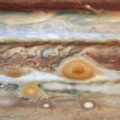
Hundreds of observations of the Jovian system are taking place this week, including scans of Jupiter's turbulent atmosphere, measurements of its magnetosphere, surveys of its delicate rings, maps of the composition and topography of the large moons Io, Europa, Ganymede (pictured) and Callisto, and a detailed look at volcanic activity on Io. While much of the close-in science data will be sent back to Earth during the coming weeks, the team will download a sampling of images this week to verify New Horizons' performance.

New Horizons' journey also includes the first-ever trip down the long "tail" of Jupiter's magnetosphere, a wide stream of charged particles that extends more than 100 million miles beyond the planet.

Check out the New Horizons website for more pics

Source: Johns Hopkins University


Discuss this article in our forum

Home         All The News      Science Forum         Books, Books, Books         Curiosity Shop         About

The terms and conditions governing your use of this website.
Copyright © 1997 - 2010 Science a Go Go and its licensors. All rights reserved.