Home   |   News   |   Discussion Forum   |   Books   |   Curiosity Shop
Discussion Forum
Recent Posts
About physics and consistency of mathematical theo
Adib Ben Jebara
01:04 AM
Atemporal Universe?
amrito
12:50 AM
Philosophy of Religions--all religions, including,
redewenur
10:00 PM
About time for elementary particles
redewenur
09:44 PM
What Would We Choose To Do If...
Ellis
06:07 PM
The Big Crunch will happen after an infinite time
Zephir
02:02 AM
There always existed a universe
Zephir
01:26 AM
Getting to rational eco-footprint levels?
samwik
12:53 AM
Terra Preta Soils to Save the Biosphere
samwik
07/17/08 11:05 PM
Type I civilization: can we make it?
Ellis
07/17/08 10:14 PM
Hot Topics

The Environment

Evolution

Space

Mind/Brain

Electronics

Climate Change


Search
Custom Search
Sponsored Links
Most Read
Hormones Gone Wild
Homo Superior
The Universe As Magic Roundabout
In Space, No One Can Hear You Say "Doh!"
Bow To Your Insect Overlords!
Bionics
Sex And The Schizoid Factor
Delusions And Mental Illness
We Come In Peace – NOT!
Eeew!
Small Penis Syndrome A Big Problem?
Have You Hugged Your Robot Today?
Down On The Farm - Yields, Nutrients And Soil Quality
Cat Parasite Has Global Ambitions
POP Goes The Planet
The Disappearing Male
Missing Link A Tripping Chimp?
Inorganic Dust Formations Alive?
Science Shopping
Sci Shop
Peculiar scientific stuff that you didn't even know existed and you don't need.
News And Research

Physics

Climate Change

Space

Natural World

Health

Technology


All 2008 News

Rusty's Reading List
Sci Books
Join Rusty Rockets for the lowdown on what you should be reading.
Archives
2008 2007
2006 2005 2004
2003 2002 2001
2000 1999 1998
Discussions
Features


18 December 2006
Direct Brain Control Of Robot Demonstrated
by Kate Melville

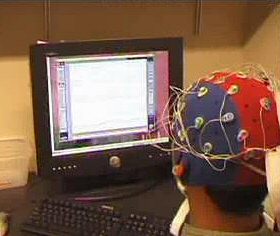
A metal skullcap with electrodes sticking out has turned a sci-fi cliché into reality, with the wearer being able to control a robot's movements with thought power alone. University of Washington researcher, Rajesh Rao, has demonstrated that an individual can "order" the robot to move to specific locations and pick up specific objects merely by generating the proper brain wave instructions.

"This is really a proof-of-concept demonstration," Rao said, when he presented his results at the Current Trends in Brain-Computer Interfacing meeting. "It suggests that one day we might be able to use semi-autonomous robots for such jobs as helping disabled people or performing routine tasks in a person's home."

The controlling individual (a graduate student in the demonstration) wears a cap dotted with 32 electrodes which pick up brain signals from the scalp based on a technique called electroencephalography. The person watches the robot's movements on a computer screen via two cameras, one mounted on the robot and another above it, and "thinks" which way the robot should move.

Currently, the "thought commands" are limited to a few basic instructions; choosing one of two available objects, picking it up, and carrying it to one of two locations. Impressively, preliminary results show 94 percent accuracy in choosing the correct object.

"One of the important things about this demonstration is that we're using a 'noisy' brain signal to control the robot," Rao explained. "The technique for picking up brain signals is non-invasive, but that means we can only obtain brain signals indirectly from sensors on the surface of the head, and not where they are generated deep in the brain. As a result, the user can only generate high-level commands such as indicating which object to pick up or which location to go to, and the robot needs to be autonomous enough to be able to execute such commands."

The research team has plans to extend the research to use more complex objects and equip the robot with skills such as avoiding obstacles in a room. Rao also wants to make the robot's behavior more adaptive to the environment, which means the robot's programming must enable some kind of learning to occur.

Check out some video of the robot in action.
Source: University of Washington


Home   |   News   |   Discussion Forum   |   Books   |   Curiosity Shop   |   About
The terms and conditions governing your use of this website.
Copyright © 1997 - 2008 Science a Go Go and its licensors. All rights reserved.