Home   |   News   |   Discussion Forum   |   Books   |   Curiosity Shop
Discussion Forum
Science Talk
Discuss scientific conundrums with our motley band of bamboozled boffins.
Latest Posts
a serious question to the forum
by Zephir
0 seconds ago
The Concept of the Whole and Threadism
by Kyra M
Today at 02:47 AM
Why is our blood red
by janelee
Yesterday at 10:17 PM
Unified Field Theory?
by TheodoreToth
Yesterday at 08:41 PM
CFL - tempers in the house of (representatives ? )
by paul
Yesterday at 08:10 PM
Search
Custom Search
Sponsored Links
Most Read
Hormones gone wild
Homo superior
New IPCC climate warning
In space, no one can hear you say "doh!"
Bow to your insect overlords!
Penis enlargement surprise: it's possible
Sex and the schizoid factor
Delusions and mental illness
We come in peace – not!
Eeew!
Small penis syndrome a big problem?
Have you hugged your robot today?
Down on the farm - yields, nutrients and soil quality
Cat parasite has global ambitions
Pop goes the planet
The disappearing male
Missing link a tripping chimp?
Inorganic dust formations alive?
Science Shopping
Sci Shop
Peculiar scientific stuff that you didn't even know existed and you don't need.
News And Research

Physics

Climate Change

Space

Natural World

Health

Technology


All 2009 News

Science Books
Book Reviews
Rusty Rockets reviews this week's science titles and lists his all-time faves.
Archives
2009 2008 2007
2006 2005 2004
2003 2002 2001
2000 1999 1998
Discussion Archive
Feature Archive


22 August 2006
Forget The Thermometer, The Mercury Really Is Rising
by Kate Melville

The wide range of detrimental flow-on effects triggered by climate change continues to surprise scientists. An article in the latest issue of Geophysical Research Letters reveals how climate change appears to be contributing to the release of high levels of mercury in the northern wetlands of North America. The new report was compiled by Michigan State University (MSU) researcher Merritt Turetsky, working closely with the U.S. Geological Survey.

Humans have been releasing mercury into the atmosphere since the start of the Industrial Revolution. Eventually, it falls back to Earth - more often than not in North American wetland areas - where it is sequestered by the peat soils. While mercury is poisonous and ideally not something you'd really want in wetlands; the cold, wet soils of the boreal forest region in Alaska and northern Canada are in fact efficient resting places for mercury. "This type of wetland is actually doing us a service. Peat lands have been storing mercury from the atmosphere since well before and during the Industrial Revolution, locking it in peat where it's not causing any biological harm, away from the food web," explained Turetsky.

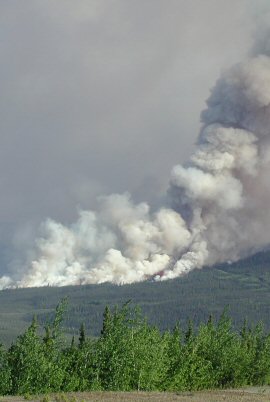
To compile the report, Turestsky and his co-researchers measured the amount of mercury stored in soils and vegetation of forests and peat lands; then used historical burn areas and emission models to estimate how much of that mercury is released into the atmosphere during fires. The researchers also sampled smoke plumes to measure atmospheric mercury levels as fires burnt.

The findings indicate that the drier conditions brought about by a warming climate will cause the soil to relinquish its hold on hundreds of years of mercury accumulation, sending that mercury back into the air at levels up to 15 times greater than originally calculated. "While peat lands are typically viewed as very wet and stagnant places, they do burn in continental regions, especially late in the season when water tables are depressed," explained Turetsky. "When peat lands burn, they can release a huge amount of mercury that overwhelms regional atmospheric emissions. Our study is new in that it looks to the soil record to tell us what happens when peat soil burns, soil that has been like a sponge for mercury for a long time."

"Environmental mercury is just like a thermometer. Levels will rise in the atmosphere with climate change, but due to increasing fire activity in the north and not solely due to warming," said Jennifer Harden, a soil scientist at the U.S. Geological Survey and co-author of the study. "We're talking about mercury that has been relatively harmless, trapped in peat for hundreds of years, rapidly being spewed back into the air," Turetsky added. "Some of it will fall into lakes and streams where it could become toxic in food chains. Our findings show us that climate change is complex and will contribute to the pollution of food chains that are very far away from us."

Source: Michigan State University
Pic courtesy MSU


Home            News            Discussion Forum            Books            Curiosity Shop            About

The terms and conditions governing your use of this website.
Copyright © 1997 - 2009 Science a Go Go and its licensors. All rights reserved.