Home   |   News   |   Discussion Forum   |   Books   |   Curiosity Shop
Discussion Forum
Science Talk
Discuss scientific conundrums with our motley band of bamboozled boffins.
Latest Posts
a serious question to the forum
by Zephir
0 seconds ago
The Concept of the Whole and Threadism
by Kyra M
Today at 02:47 AM
Why is our blood red
by janelee
Yesterday at 10:17 PM
Unified Field Theory?
by TheodoreToth
Yesterday at 08:41 PM
CFL - tempers in the house of (representatives ? )
by paul
Yesterday at 08:10 PM
Search
Custom Search
Sponsored Links
Most Read
Hormones gone wild
Homo superior
New IPCC climate warning
In space, no one can hear you say "doh!"
Bow to your insect overlords!
Penis enlargement surprise: it's possible
Sex and the schizoid factor
Delusions and mental illness
We come in peace – not!
Eeew!
Small penis syndrome a big problem?
Have you hugged your robot today?
Down on the farm - yields, nutrients and soil quality
Cat parasite has global ambitions
Pop goes the planet
The disappearing male
Missing link a tripping chimp?
Inorganic dust formations alive?
Science Shopping
Sci Shop
Peculiar scientific stuff that you didn't even know existed and you don't need.
News And Research

Physics

Climate Change

Space

Natural World

Health

Technology


All 2009 News

Science Books
Book Reviews
Rusty Rockets reviews this week's science titles and lists his all-time faves.
Archives
2009 2008 2007
2006 2005 2004
2003 2002 2001
2000 1999 1998
Discussion Archive
Feature Archive


22 March 2006
Chimps Command To Conquer An Itch
by Kate Melville

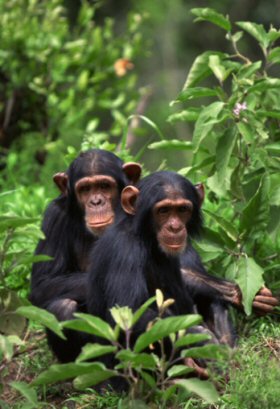
A paper entitled "Referential Gestural Communication in Wild Chimpanzees," recently published in Current Biology, shows that chimpanzees (Pan troglodytes) can effectively command their chimp buddies around using hand gestures just like their human relatives. This observation runs counter to previously held assumptions that "referential" gestures used to direct the attentions of others were a distinctly human trait.

Scientists have already observed captive chimps and language-trained apes that habitually use "directed scratches" to request grooming of specific areas on the body, but these behaviors cannot be considered intrinsic to chimps while in the presence of humans. To discover whether referential gesturing was a fundamental form of communication among chimps, University of Michigan anthropology professor John Mitani, and his colleague Simone Pika, from the University of St. Andrews in Scotland, analyzed chimps' behavior in the wild. "The more we learn, the more we see chimpanzees employing remarkable, seemingly human-like behaviors," Mitani said. "To me that is one of the lessons of this little paper." Mitani further claims that: "our closest living relatives may be capable of mental-state attribution, making inferences about the knowledge of others."

The team's conclusions are based on their observations of male chimps living in the Ngogo community in Uganda's Kibale National Park. They used male chimps as their subjects because males engage in grooming activities far more often than females. Mitani and Pika watched as the male chimps directed their grooming partners to a spot in need of a good scratch by using loud, exaggerated gestures. "In 64 percent of cases," says Mitani, "the groomer responded immediately by stopping and moving to groom the exact spot the gesturer had just scratched."

Like humans, male chimps rely on friendships, or others who might be a "soft touch", when it comes to accommodating their needs. As such, the team observed that "directed scratching" occurred most frequently among males who formed strong social bonds. "It's almost as if it's being used selectively by males who know that they are going to obtain a positive response; similar to asking a friend for a favor as opposed to a stranger," Mitani said. He added that: "further study might reveal that males who do not display such friendly relations do not engage in the behavior as often."

Check out a short video of some chimps scratching…

Source: University of Michigan


Home            News            Discussion Forum            Books            Curiosity Shop            About

The terms and conditions governing your use of this website.
Copyright © 1997 - 2009 Science a Go Go and its licensors. All rights reserved.