Home   |   News    |   Discussions   |   Books   |   Curiosities
Search
Custom Search
Popular Reads

Earthquakes and animal behavior
LHC may produce time travelling particles
Country boys boast bigger junk
Running the numbers on alien life
Uh-oh, placebo
Forgetful? Blame your house
Pill to blame for rise in prostate cancer?
Cat parasite has global ambitions
Carbon monoxide keeps city dwellers happy
Magnetic field alters moral judgments
Stars manufacturing organic matter?
Unnatural selection: Courtesy of The Pill
Men 2% funnier than women
Parasite rewires sexual attraction
Novel psychiatric drugs take aim at gut bacteria
Discussions
General Science

Not-Quite Science

Physics

Climate Change

Science Fiction

Past Forums

Sponsored Links
Browse

Animal Kingdom

Biology

Climate Change

Environment

Evolution

Genetics

Humans

Mind & Brain

Prehistory

Health & Diet

Health Threats

Health & Environment

Health: From The Lab

Mental Health

Reproductive Health

Energy Alternatives

Chemistry

Computing & Electronics

Nanotechnology

Pimping Nature

Robotics & AI

Physics

Space


Curiosities
Sci Shop
Peculiar and bizarre scientific stuff that you didn't even know existed and you don't need.
Books
Book Reviews
Rusty Rockets lists his all-time favorite science titles.
Archives
2012 2011 2010
2009 2008 2007
2006 2005 2004
2003 2002 2001
2000 1999 1998
Feature Archive


20 July 2005
Bird Poo Spreading Toxic Pollutants
by Kate Melville

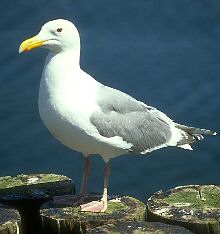
Mother Nature herself may be implicated in a worrying rise in levels of DDT and mercury in otherwise pristine Canadian ecosystems. A new study suggests that the culprits are seabirds that transport and deliver the contaminants in their poo. Surprisingly, the researchers found that the seabirds were responsible for transporting most of the human-made contaminants to some coastal ecosystems. "The effect is to elevate concentrations of pollutants such as mercury and DDT to as much as 60 times that of areas not influenced by seabird populations," said researcher John Smol, from Queen's University.

The study, appearing in Science, noted that contaminants washed into the ocean did not, as was believed, cease to affect terrestrial ecosystems. "Our study shows that sea birds, which feed in the ocean but then come back to land, are returning not only with food for their young but with contaminants as well. The contaminants accumulate in their bodies and are released on land," said study leader Jules Blais. "We now have evidence that seabirds can concentrate industrial contaminants in coastal areas to levels that can be affecting those ecosystems."

Because of the chemical build up in the food web, the researchers said that some communities in northern Canada are among the most mercury and PCB-exposed people on the globe.

Adding to the concern is the fact that Canada has the longest coastline in the world and seabirds are typically the dominant wildlife found in coastal ecosystems. "Most of Canada's coastline is at our northern fringe, and northern aboriginal communities rely on these ecosystems as a source of nutrition, economic development, traditional customs, and culture," noted Blais.


Social

Follow Science a GoGo


Home         All The News      Science Forum         Books, Books, Books         Curiosity Shop         About

The terms and conditions governing your use of this website.
Copyright © 1997 - 2012 Science a Go Go and its licensors. All rights reserved.