
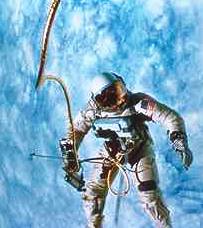
As the Russian service module “Zvezda” nears its July 25 rendezvous with the International Space Station, stargazers and space enthusiasts can track the progress of construction on the ambitious space research facility.
And they can do it with the naked eye.
A new Web site developed at NASA’s Marshall Space Flight Center in Huntsville, Ala., is making it easy and exciting for enthusiasts across the country and around the world to catch a glimpse of the orbiting facility.
The “Liftoff to Space Exploration” Web site at http://liftoff.msfc.nasa.gov/ lets users identify the orbiting Space Station — and determine in advance when it will pass over their hometowns. The site relies on a sophisticated, Java-based program called J-Pass, developed by Patrick Meyer, a data systems engineer at the Marshall Center.
J-Pass displays user-friendly tracking information provided by the North American Aerospace Defense Command (NORAD). It permits site visitors to track not only the International Space Station, but also the Russian station Mir, Space Shuttle missions, and other objects in Earth orbit.
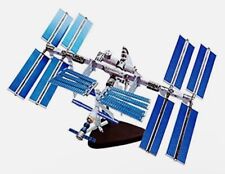
Orbiting at more than 200 miles above the Earth, the Space Station is quickly growing into one of the brightest permanent fixtures in the night sky. Currently consisting of the American connecting module “Unity” and the Russian control module “Zarya,” the Station circles the planet approximately 16 times per day, traveling at 17,500 mph in an orbit varying 208 to 285 miles from Earth.
Because it reflects sunlight down to Earth, the Space Station often looks like a slow-moving star as it crosses the sky. That deceptive appearance can fool a casual viewer. But it also makes sighting the Station easier if one knows when and where to look for it.
Viewed under optimal conditions, the Station has been observed to appear nearly as bright as the star Sirius. When construction is complete, estimates suggest the 470-ton “city in space” will be brighter than the planet Venus.
Related posts:
 Space station experiment identifies microbes that can survive unprotected in space
 Curiosity rover finally demystifies radiation hazards on Mars
 “I’m back!” Comet ISON hangs on in there
 Astronomers Get Gnarly Over Planetary Definitions
 Disrupted biological clock damages brain
 Cough Medicines No Better Than Placebo

Comments are closed.