Home   |   News    |   Discussions   |   Books   |   Curiosities
Search
Custom Search
Popular Reads

Earthquakes and animal behavior
LHC may produce time travelling particles
Country boys boast bigger junk
Running the numbers on alien life
Uh-oh, placebo
Forgetful? Blame your house
Pill to blame for rise in prostate cancer?
Cat parasite has global ambitions
Carbon monoxide keeps city dwellers happy
Magnetic field alters moral judgments
Stars manufacturing organic matter?
Unnatural selection: Courtesy of The Pill
Men 2% funnier than women
Parasite rewires sexual attraction
Novel psychiatric drugs take aim at gut bacteria
Discussions
General Science

Not-Quite Science

Physics

Climate Change

Science Fiction

Past Forums

Sponsored Links
Browse

Animal Kingdom

Biology

Climate Change

Environment

Evolution

Genetics

Humans

Mind & Brain

Prehistory

Health & Diet

Health Threats

Health & Environment

Health: From The Lab

Mental Health

Reproductive Health

Energy Alternatives

Chemistry

Computing & Electronics

Nanotechnology

Pimping Nature

Robotics & AI

Physics

Space


Curiosities
Sci Shop
Peculiar and bizarre scientific stuff that you didn't even know existed and you don't need.
Books
Book Reviews
Rusty Rockets lists his all-time favorite science titles.
Archives
2012 2011 2010
2009 2008 2007
2006 2005 2004
2003 2002 2001
2000 1999 1998
Feature Archive


31 August 2010
First human communities may have originated from funeral feasts
by Kate Melville

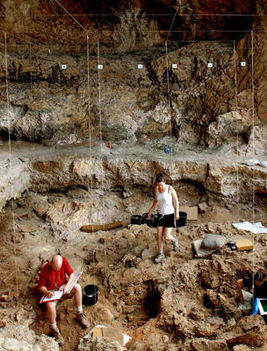
University of Connecticut (UC) scientists working at a 12,000 year-old archeological site in Israel say they have evidence that ancient feasts to celebrate the burial of the dead brought about the world's first established communities.

UC anthropologist Natalie Munro and co-workers found clear evidence of feasting at the ancient Hilazon Tachtit Cave burial site near Karmiel, Israel. Unusually high densities of butchered tortoise and wild cattle led them to conclude that the Natufian community members who lived in the area at the time gathered at the site for special rituals to commemorate the burial of the dead, and that feasts were central elements. The Natufian people occupied the area around Karmiel, near the Mediterranean Sea some 14,500 to 11,500 years ago.

"Feasting [...] is one of humanity's most universal and unique social behaviors," the researchers write in their report published in the Proceedings of the National Academy of Sciences. "Our paper documents the first good evidence for feasting in the archaeological record that we know of," says Munro.

Munro contends that the ancient feasting signaled important culture changes. The Natufian people were the first to settle into more or less permanent communities and the act of settling would have been a time of social and economic upheaval. Prior to this, populations were more mobile and could separate into smaller groups for food and other resources to deal with disputes. Settling down probably strained social relationships, adds Munro, who theorizes that feasts may have played a significant role in easing the potentially rocky transition from a hunting-gathering lifestyle to one of agricultural dependency.

"Sedentary communities require other means to resolve conflict, smooth tensions and provide a sense of community," said Munro. "We believe that feasts, especially in funerary contexts, served to integrate communities by providing this sense of community."

Funerals may have provided special opportunities to bring communities together to mark the last event in a person's life and send the deceased off to another life, Munro speculates. Instilled with additional layers of spiritual meaning, they may have provided an opportunity to commemorate an individual's life and soothe social disputes. And it appears that feasts would have played a significant role in that.

Related:
Did Civilization Emerge Thanks To A Change In The Weather?
Did population density create modern humans?
Food For Thought Ancient Man Spread The Love Around


Source: National Science Foundation
Pic courtesy Lisa Raffensperger, National Science Foundation


Social

Follow Science a GoGo


Home         All The News      Science Forum         Books, Books, Books         Curiosity Shop         About

The terms and conditions governing your use of this website.
Copyright © 1997 - 2012 Science a Go Go and its licensors. All rights reserved.