Home   |   News   |   Discussion Forum   |   Books   |   Curiosity Shop
Discussion Forum
Science Talk
Discuss scientific conundrums with our motley band of bamboozled boffins.
Latest Posts
The Concept of the Whole and Threadism
by Kyra M
0 seconds ago
Why is our blood red
by janelee
Yesterday at 10:17 PM
Unified Field Theory?
by TheodoreToth
Yesterday at 08:41 PM
CFL - tempers in the house of (representatives ? )
by paul
Yesterday at 08:10 PM
a serious question to the forum
by paul
Yesterday at 07:22 PM
Search
Custom Search
Sponsored Links
Most Read
Hormones gone wild
Homo superior
New IPCC climate warning
In space, no one can hear you say "doh!"
Bow to your insect overlords!
Penis enlargement surprise: it's possible
Sex and the schizoid factor
Delusions and mental illness
We come in peace – not!
Eeew!
Small penis syndrome a big problem?
Have you hugged your robot today?
Down on the farm - yields, nutrients and soil quality
Cat parasite has global ambitions
Pop goes the planet
The disappearing male
Missing link a tripping chimp?
Inorganic dust formations alive?
Science Shopping
Sci Shop
Peculiar scientific stuff that you didn't even know existed and you don't need.
News And Research

Physics

Climate Change

Space

Natural World

Health

Technology


All 2009 News

Science Books
Book Reviews
Rusty Rockets reviews this week's science titles and lists his all-time faves.
Archives
2009 2008 2007
2006 2005 2004
2003 2002 2001
2000 1999 1998
Discussion Archive
Feature Archive


4 September 2008
New findings challenge long-held assumptions about flightless bird evolution
by Kate Melville

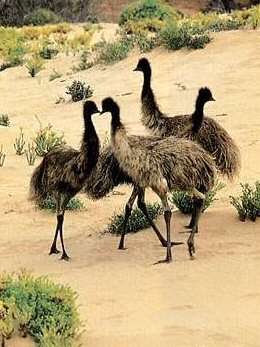
University of Florida zoologists say that large flightless birds such as the ostrich and emu do not share a common flightless ancestor as once believed. Instead, each species individually lost flight after diverging from ancestors that did have the ability to fly.

Edward Braun and his fellow researchers began closely studying this group of flightless birds (known collectively as ratites) after they noticed that the ratites did not form a natural group based on their genetic makeup. Rather, they belonged to multiple related but distinct groups that contained another group of birds, the tinamous, with the ability to fly.

Previously, the ratites were used as a textbook example of vicariance, a term that describes the geographical division of a single species, resulting in two or more very similar sub-groups that can then undergo further evolutionary change and eventually become very distinct from one another.

Scientists assumed that a single flightless common ancestor of the ratites lived on the supercontinent of Gondwana, which slowly broke up into Africa, South America, Australia and New Zealand; once divided, the ancestor species evolved slightly in each new location to produce the differences among the present-day ratites, Braun explained. But in light of this new information, he said it's more likely that the ratites' ancestors distributed themselves among the southern continents after the breakup of Gondwana, which began about 167 million years ago, in a much more obvious way. They flew.

The study, appearing in the Proceedings of the National Academy of Sciences, has several important implications, says Braun. He contends it means some ratites, like the emus, are much more closely related to their airborne cousins, the tinamous, than they are to other ratites. And second, it means the ratites are products of parallel evolution - different species in significantly different environments following the exact same evolutionary course.

Although these new revelations teach evolutionary scientists a great deal, they also pose a great many new questions. For example, why did these birds evolve into such similar organisms in such different environments? "To know for sure, we'll have to go into the lab and really study the genetics underlying the ratites' developmental pathway," Braun said. "But nobody would have asked that question without the type of data we've collected, which raises the question in the first place."

Related:
Darwin's Dilemma Solved?
Evolutionary Changes Not Always Small

Source: University of Florida


Home            News            Discussion Forum            Books            Curiosity Shop            About

The terms and conditions governing your use of this website.
Copyright © 1997 - 2009 Science a Go Go and its licensors. All rights reserved.