
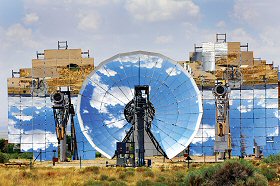
Sandia National Laboratories and Stirling Energy Systems (SES) have set a new solar-to-grid system conversion efficiency record by achieving a 31.25 percent net efficiency rate. The old 1984 record of 29.4 percent was toppled using SES’s “Serial #3” solar dish Stirling system at Sandia’s National Solar Thermal Test Facility.
Serial #3 is part of a prototype six-dish model power plant at the Solar Thermal Test Facility that produces up to 150 kilowatts (kW) of grid-ready electrical power during the day. Each dish unit consists of 82 mirrors formed in a dish shape to focus the light to an intense beam.
The solar dish generates electricity by focusing the sun’s rays onto a receiver, which transmits the heat energy to a Stirling engine. The engine is a sealed system filled with hydrogen. As the gas heats and cools, its pressure rises and falls. The change in pressure drives the pistons inside the engine, producing mechanical power, which in turn drives a generator and makes electricity.
“Gaining two whole points of conversion efficiency in this type of system is phenomenal,” says Bruce Osborn, SES president and CEO. “This is a significant advancement that takes our dish engine systems well beyond the capacities of any other solar dish collectors and one step closer to commercializing an affordable system.”
Lead Sandia project engineer Chuck Andraka says that several technical advancements to the systems led to the record-breaking solar-to-grid conversion efficiency. The first and probably most important advancement was improved optics. The Stirling dishes are made with a low iron glass with a silver backing that make them highly reflective -focusing as much as 94 percent of the incident sunlight to the engine package, where prior efforts reflected about 91 percent.
Other advancements to the solar dish-engine system that helped Sandia and SES beat the energy conversion record were a new, more effective radiator that also costs less to build and a new high-efficiency generator.
While all the enhancements led to a better system, the weather also played a pivotal role. “It was a ‘perfect storm’ of sorts,” Andraka says. “We set the record on Jan. 31, a very cold and extremely bright day, a day eight percent brighter than normal.” The temperature, which hovered around freezing, allowed the cold portion of the engine to operate at about 23 degrees C, and the brightness means more energy was produced while most parasitic loads and losses are constant. The test ran for two and a half hours, and a 60-minute running average was used to evaluate the power and efficiency data, in order to eliminate transient effects. During the testing phase, the system produced 26.75 kW net electrical power.
Osborn says that SES is working to commercialize the record-performing system and has signed power purchase agreements with two major Southern California utilities (Southern California Edison and San Diego Gas & Electric) for up to 1,750 megawatts (MW) of power, representing the world’s two largest solar power contracts. Collectively, these contracts require up to 70,000 solar dish engine units.
Related:
Solar Cell Efficiency Approaching 50%
Race Is On For Efficient Organic Solar Cells
Electrokinetic Generation May Challenge Solar, Wind Power











Comments are closed.