
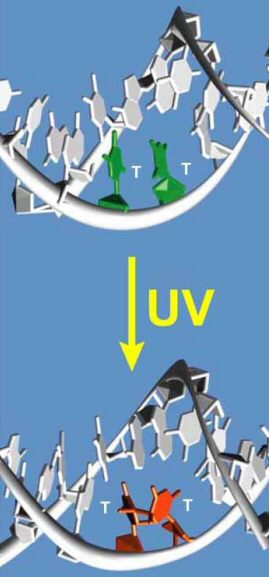
Ohio State University chemists and their colleagues in Germany have used a special technique to watch strands of DNA sustain damage from ultraviolet (UV) light in real time. They discovered that the key reaction on the DNA molecule that is linked to sunburn happens with astounding speed – in less than one picosecond. Writing about their work in the journal Science, the researchers said that studying UV damaged DNA would allow greater understanding of the role it plays in diseases such as skin cancer.
When UV light hits the DNA molecule it adds energy, or excites the molecule, explained researcher Bern Kohler. Some excited energy states last a long time, and others a short time. Occasionally, the energy triggers a chemical reaction that alters the DNA’s molecular structure. Previously, scientists believed that the longer a DNA molecule was excited by UV energy, the greater the chance that it would sustain damage. It had always been believed that long-lived excited states were thought to be more dangerous than short-lived ones but this study shows that the most common UV damage is caused by a very short-lived excited state.
DNA has its own self-repair functions, but when it sustains too much damage, these can’t function properly. Badly damaged cells simply die – the effect that gives sunburn its sting. Scientists also believe that chronic damage creates mutations that lead to diseases such as skin cancer.
To observe the damage taking place, the team used a technique called transient absorption. Transient absorption is based on the idea that molecules absorb light at specific wavelengths, and it allows researchers to study events that happen in less than a picosecond. This is the first time anyone has observed the initial molecular events behind damage to DNA and Kohler thinks the results might make scientists attack the problem of UV damage in a new way.
The DNA in a cell is constantly in motion. It bends and twists and this flexibility enables the normal chemical reactions that are constantly happening in the cell. Each shape-shift can require anywhere from a few to several hundred picoseconds to complete. While these shifts are fast, the new study shows that UV damage happens many times faster. That means that whether or not two thymine bases are damaged depends on the position of the DNA during the extremely brief time required for it to absorb UV light. Either two thymine bases are lined up in just the right way to bond when the UV hits, or they’re not.
“This insight explains why some pairs of thymine bases get damaged more frequently than others, and it suggests that scientists can understand damage patterns to DNA by studying the factors that influence how the bases are arranged in space,” Kohler said.



Comments are closed.