Home   |   News   |   Discussion Forum   |   Books   |   Curiosity Shop
Discussion Forum
Science Talk
Discuss scientific conundrums with our motley band of bamboozled boffins.
Hot Topics

The Environment

Evolution

Space

Mind/Brain

Electronics

Climate Change


Search
Custom Search
Sponsored Links
Most Read
Hormones gone wild
Homo superior
The universe as magic roundabout
In space, no one can hear you say "doh!"
Bow to your insect overlords!
Bionics
Sex and the schizoid factor
Delusions and mental illness
We come in peace – not!
Eeew!
Small penis syndrome a big problem?
Have you hugged your robot today?
Down on the farm - yields, nutrients and soil quality
Cat parasite has global ambitions
Pop goes the planet
The disappearing male
Missing link a tripping chimp?
Inorganic dust formations alive?
Science Shopping
Sci Shop
Peculiar scientific stuff that you didn't even know existed and you don't need.
News And Research

Physics

Climate Change

Space

Natural World

Health

Technology


All 2008 News

Rusty's Reading List
Sci Books
Join Rusty Rockets for the lowdown on what you should be reading.
Archives
2008 2007
2006 2005 2004
2003 2002 2001
2000 1999 1998
Discussion Archive
Feature Archive


17 August 2005
Milky Way Not Your Average Spiral Galaxy
by Kate Melville

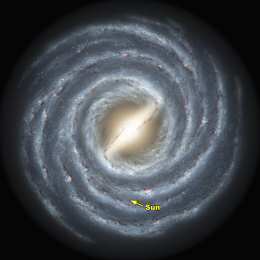
Using NASA's Spitzer Space Telescope, astronomers have been conducting a comprehensive structural analysis of our galaxy and found intriguing new evidence that the Milky Way is quite different from what we believe to be an ordinary spiral galaxy. The study, appearing in Astrophysical Journal Letters, reveals details of a long central bar feature that distinguishes the Milky Way from more average spiral galaxies.

Using Spitzer's infrared capabilities, the astronomers surveyed some 30 million stars in the plane of the galaxy in an effort to build a detailed portrait of the inner regions of the Milky Way. Such tasks are difficult, akin to trying to describe the boundaries of a forest from a vantage point deep within the woods. "This is hard to do from within the galaxy," said astronomer Ed Churchwell.

The telescope allowed the astronomers to cut through the obscuring clouds of interstellar dust and gather infrared starlight from tens-of-millions of stars at the center of the galaxy. They believe the new survey gives the most detailed picture to date of the inner regions of the Milky Way. "We're observing at wavelengths where the galaxy is more transparent, and we're bringing tens of millions of objects into the equation," said Robert Benjamin, the lead author of the new study. The new research, the University of Wisconsin-Madison astronomers say, clearly shows a bar-like structure.

Astronomers have long pondered the possibility that the Milky Way Galaxy has a long stellar bar through its center. Such phenomena are not unheard of in galactic taxonomy and they are clearly evident in other galaxies. The new study shows a bar, consisting of relatively old, red stars, spanning the center of the galaxy roughly 27,000 light years in length - 7,000 light years longer than previously believed. It also shows that the bar is oriented at about a 45-degree angle relative to a line joining the sun and the center of the galaxy. The estimates for the size and orientation of the bar are far different from previous estimates.

"To date, this is the best evidence for a long bar in our galaxy," Benjamin concluded. "It's hard to argue with this data."

Pic courtesy NASA/JPL-Caltech/R. Hurt (SSC/Caltech)



Home            News            Discussion Forum            Books            Curiosity Shop            About

The terms and conditions governing your use of this website.
Copyright © 1997 - 2008 Science a Go Go and its licensors. All rights reserved.